Yujing Li,
Department of Human Genetics
Emory University School of Medicine, USA
Yue Zhang, Univerity of Montreal, Research Center, CHUM, Canada
In-Hyun Park,
Department of Genetics
Yale School of Medicine, USA
PUBMED NLM-ID: 101608636
Genetics is a discipline of the Biological sciences that studies personal traits the human or living organism inherit from its ancestors through genes and Embryology studies the development of the fertilized embryo from the ovum to the fetus stage.
Journal of Human Genetics and Embryology is a peer-reviewed scientific journal known for the rapid dissemination of high-quality research. This Human Genetics Journal with high impact factor offers an open-access platform to the authors in academia and industry to publish their novel research in the mode of original articles, review articles, case reports, short communications, etc. It serves the International Scientific Community with its standard research publications.
This scholarly publishing is using Editorial Submission and Review Tracking System for quality in the review process. Tracking System is an online manuscript submission, review and tracking system. Review process is performed by the editorial board members of Human Genetics & Embryology journal or outside experts; at least two independent reviewer’s approval followed by the editor is required for the acceptance of any citable manuscript. Authors may submit manuscripts on Online Submission and Review Tracking System or send as an e-mail attachment to the Editorial Office at editor@hilarisjournal.com , track their progress through the system, hopefully to publication. Reviewers can download manuscripts and submit their opinions to the editor. Editors can manage the whole submission/review/revise/publish process.
Rapid Publication Service
Hilaris Publishing is offering wide range of opportunities, options and services for the prospective authors to publish their scholarly contributions.
The journal caters to the demands of the fast publication without compromising on the editorial quality including manuscript peer-review. This flexibility is being provided to ensure earliest author credibility to their respective contributions and this will also ensure timely dissemination of research outcomes for efficient integration, effective translation and reduced redundancy.
Authors have the option to choose between the standard open access publication service which takes its own course of time for complete publication process or can opt for rapid publication service wherein the article is published at the earliest date (Includes multiple subject experts commissioning for securing earliest peer-review comments). The authors can avail this flexibility based on the personal preference, funding agency guidelines or Institutional or organizational requirements.
Regardless of the option, all manuscripts undergo thorough peer-review process, editorial assessment and production process.
Fast Editorial Execution and Review Process (FEE-Review Process)
Authors who are willing to publish their articles under this mode can make a pre-payment of $99 towards express peer-review and editorial decision. First editorial decision in 3 days and final decision with review comments in 5 days from the date of submission. Galley proof generation will be done in next 2 days from acceptance or maximum 5 days (For manuscripts notified for revision by external reviewer).
Manuscripts accepted for publication will be charged regular APC.
Authors retain the copyright of their publication and the final version of the article will be published in both HTML and PDF formats as well as XML formats for transmitting to indexing databases. The editorial team of the Journal will ensure adherence to scientific publication guidelines.
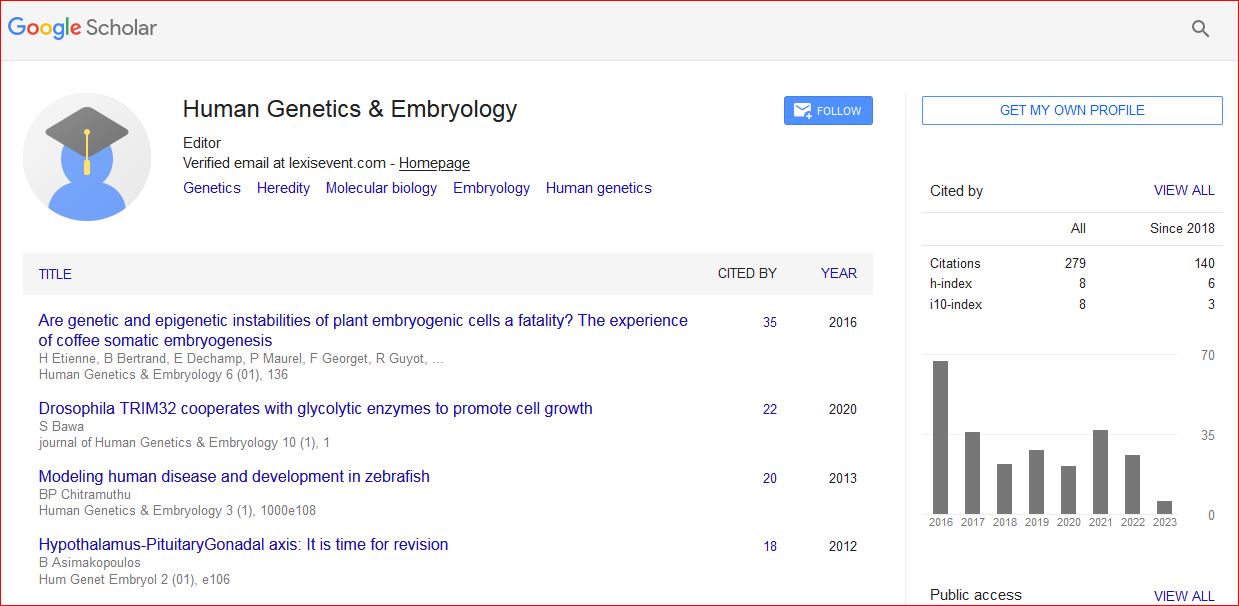
Articles published in Human Genetics & Embryology have been cited by esteemed scholars and scientists all around the world. Human Genetics & Embryology has got h-index 9 , which means every article in Human Genetics & Embryology has got 9 average citations.

David I Smith
Market Analysis
Human Genetics & Embryology received 309 citations as per Google Scholar report

 Spanish
  Chinese
  Russian
  German
  French
  Japanese
  Portuguese
  Hindi
Hindi 