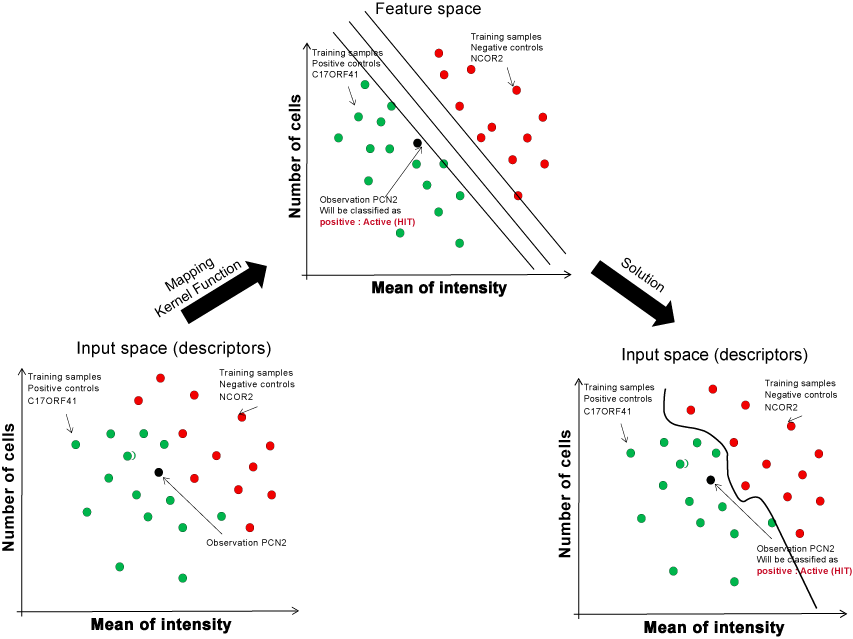
Figure 8: Support Vector Machine. Instead of restricting to individual genes, support vector machines efficiently try several
mathematical combinations of siRNAs to find the line (or plane) that best separates groups of biological samples. SVMs use
a training set in which genes known to be related by, for example function, are provided as positive examples and genes known not to be members of that class are negative examples. SVM solves the problem by mapping the image descriptor vectors from feature space into a higher-dimensional ‘feature space’, in which distance is measured using a mathematical function known as a Kernel Function, and the data can then be separated into two classes.
mathematical combinations of siRNAs to find the line (or plane) that best separates groups of biological samples. SVMs use
a training set in which genes known to be related by, for example function, are provided as positive examples and genes known not to be members of that class are negative examples. SVM solves the problem by mapping the image descriptor vectors from feature space into a higher-dimensional ‘feature space’, in which distance is measured using a mathematical function known as a Kernel Function, and the data can then be separated into two classes.