
Adverse Effects on Reproductive Outcomes for Male Vietnam War Veterans
Received: 02-Oct-2025 / Manuscript No. tyoa-25-171574 / Editor assigned: 04-Oct-2025 / PreQC No. tyoa-25-171574 (PQ) / Reviewed: 23-Oct-2025 / QC No. tyoa-25-171574 / Revised: 05-Nov-2025 / Manuscript No. tyoa-25-171574 (R) / Published Date: 28-Nov-2025
Abstract
In 1995, the Air Force Health Study (AFHS) reported analyses of reproductive outcomes for male Air Force veterans of the Vietnam War using a preliminary subset of AFHS data. They concluded that those data did not support the conclusion of adverse paternal dioxin exposure effects on reproductive outcomes. More recently, analyses of reproductive outcomes for AFHS participants were reported in several articles using a more extensive subset of the AFHS data. These articles reached the opposite conclusion for a variety of reproductive outcomes. In this article, an overview is provided of the results for these studies, initially focusing on the occurrence of major birth defects. Results for other reproductive outcomes are also addressed as well as descriptions of the methods used to conduct the analyses.
Keywords
Air Force Health Study; Dioxin; Operation Ranch Hand; Reproductive outcomes
Background
Herbicide spraying by the United States Air Force during the Vietnam War was called Operation Ranch Hand [1]. One herbicide used in these spraying operations was called Agent Orange [2], containing the toxic contaminant dioxin [3]. The Air Force Health Study (AFHS) [4,5] began in 1979 in order to evaluate whether adverse health effects might be related to exposure to Agent Orange and other herbicides used during the Vietnam War. Data were collected on health, reproductive, and mortality outcomes from 1982-2006. Participants included male Air Force Vietnam War veterans within two groups: the Ranch Hand group who participated in Operation Ranch Hand operations and the non-Ranch Hand group who served in other roles during the Vietnam War. A measure of dioxin levels [6] was obtained from blood draws, but collected only for a subset of study participants.
Analyses reported in 1995 of a preliminary subset of AFHS data led to the conclusion that "these data provide little or no support for the theory that paternal exposure to dioxin is associated with adverse reproductive outcomes after service in Southeast Asia" [7]. In contrast, more recent analyses reported in 2018-2024 of more extensive AFHS data concluded that those data provided evidence of adverse effects on reproductive outcomes due to Vietnam War service and due to paternal dioxin exposure [8-12].
The purpose of this article is to provide an overview of the results for these prior analyses of AFHS data, focusing on the impact of Vietnam War service and dioxin exposure on reproductive outcomes for AFHS participants. Summaries of results of analyses for major birth defects are presented first followed by a description of results for other reproductive outcomes. Finally, so that prior material is accessible to as wide an audience as possible, details on the methods used in these analyses are described separately.
Reported AFHS Results
The AFHS reported analyses of reproductive outcomes in 1995 for 1024 participants with measured dioxin values [7]. These participants fathered 2241 conceptions after the start of their Vietnam War service with 1773 or 79.1% resulting in live born children. There were some issues with their analysis approach. They used 10 parts per trillion (ppt) as a threshold for a large dioxin exposure without justification. They excluded data for the non-Ranch Hand participants with dioxin levels larger than 10 ppt who might have had adverse reproductive outcomes. They also excluded data for participants of both groups with dioxin levels below the quantifiable level who might have had non-adverse reproductive outcomes. They used methods that assumed independence, but reproductive outcomes for children of the same participant would likely be correlated. Their analyses emphasized differences for the Ranch Hand and non-Ranch Hand groups, but perhaps dioxin exposure independent of group membership was the more crucial issue.
Birth defects were categorized as major or minor but some were left unspecified on severity. Birth defects were considered major when they could 1. potentially affect survival, 2. require substantial medical care, 3. result in marked physical/psychological handicaps, or 4. interfere with a child's prospects for a productive and fulfilling life. Major birth defects occurred in 115 or 6.5% of the live born children. In contrast, the Center for Disease Control and Prevention (CDC) conducted a study of the prevalence of major birth defects for metropolitan Atlanta, Georgia annually over years 1978-2005 [13], including the period over which the preliminary AFHS data were collected. Birth defects were considered major when 1. they could result from a malformation, deformation, or disruption in one or more parts of the body, a chromosomal abnormality, or a known clinical syndrome, 2. are present at birth, and 3. have a serious adverse effect on health, development, or functional ability. They found that the prevalence of major birth defects was stable over time with an overall estimate of 2.76% (or 2.76 per 100 live born children). While the definitions of a major birth defect might not have been exactly the same for these two studies, a major birth defect rate for the preliminary AFHS data more than double the CDC value seems to indicate a likely adverse effect on the occurrence of major birth defects contradicting the conclusion reached by the AFHS using those preliminary data.
Available AFHS Data
In 2000, the AFHS released currently available reproductive outcome data to the Vietnam Veterans of America for 2669 participants. Of these participants, 2099 or 78.6% had measured dioxin values with 117 or 5.6% of the dioxin levels below the quantifiable level and with quantifiable values ranging from 1.25 to 314.2 ppt. Also, 2354 or 88.2% of the participants fathered more than one conception indicating the importance of accounting for possible within-participant correlation. Furthermore, 2613 participants fathered 6922 live born children with 2038 or 78.0% of these participants with measured dioxin levels fathering 5478 or 79.1% of the live born children. Major birth defects occurred for 299 or 4.3% of the live born children. Data were also available for other categories of birth defects and of developmental disabilities as described later.
Analyses of these reproductive outcome data [8-12] were conducted using adaptive statistical methods, that is, methods that adapt statistical models to the data under analysis [14]. These methods account for correlation between outcomes for children of the same participant. They can be used to adaptively identify thresholds for low versus high levels of dioxin exposure with the high level treated either as constant or increasing nonlinearly for dioxin levels above the threshold. They are based on statistical tests that are more conservative than standard tests based on p-values, that is, these tests are less likely to identify an effect as significant than standard tests. Details on these methods are presented later.
Assessment of the AFHS Conclusion
An analysis of the occurrence of a major birth defect was conducted for 2188 live born children fathered by 1160 participants with measured dioxin values and conceived after the start of participants' Vietnam War service [8]. Compared to reported AFHS analyses, the threshold for a high dioxin level was identified adaptively rather than set to 10 ppt as in reported AFHS analyses, all available data were used without excluding any data, and correlation between data for children of the same participant was accounted for. The estimated threshold was 6.3 ppt. The estimated probability of a major birth defect increased from 0.045 for a low dioxin level (£ 6.3 ppt) to 0.085 for a high dioxin level (> 6.3 ppt) with estimated odds for a major birth defect about 2.0 times larger for a high compared to a low dioxin level. These results supported the conclusion of an adverse dioxin exposure effect on the occurrence of major birth defects. They also indicated the importance of adjusting the threshold for a high dioxin level with the reproductive outcome under analysis, using all possible data, and accounting for within-participant correlation.
Annual Major Birth Defects over Time
An analysis was conducted of annual proportions of major birth defects over time [9] for 5478 live born children fathered by 2038 participants with measured dioxin levels. Conceptions occurred over a 59-year period with conceptions before/after the start of Vietnam War service occurring in years 1-38/26-59. Annual proportions are displayed in [Figure 1], broken down by conceived before versus after the start of Vietnam War service. Proportions tended to be larger when conceived after the start of Vietnam War service. Analyses accounted for correlation over time and for possible nonlinearity in time [Figure 2]. Displays the estimated probabilities over time. For children conceived before the start of Vietnam War service, the estimated probability of a major birth defect was constant over time at 2.6%, close to the value reported in the CDC study. On the other hand, for children conceived after the start of Vietnam War service, estimated probabilities were larger and decreased over time from 11.7% to 4.4%. These results supported the conclusion of an adverse Vietnam War service effect on the annual proportion of major birth defects.
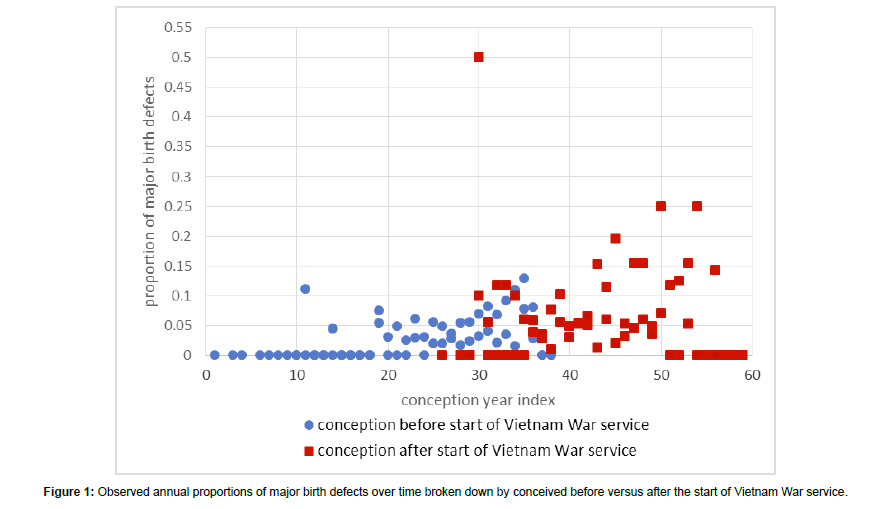
Figure 1: Observed annual proportions of major birth defects over time broken down by conceived before versus after the start of Vietnam War service.

Figure 2: Estimated annual probabilities of a major birth defect over time broken down by conceived before versus after the start of Vietnam War service.
An assessment was also conducted of whether this Vietnam War service effect can be attributed in part to dioxin exposure. Annual proportions of major birth defects were modeled in terms of two groups: children conceived after the start of Vietnam War service for participants with a high dioxin level using the threshold 6.3 ppt identified earlier compared to all other children (i.e., conceived before with either a low or high dioxin level or conceived after with a low dioxin level) [Figure 3]. Displays the estimated probabilities over time. For children conceived after the start of Vietnam War service fathered by participants with a high dioxin level, estimated probabilities decreased over time from 13.9% to 6.7% always larger than the estimated probability of 2.6% for the other children. These results supported the conclusion of an adverse effect on the annual proportion of major birth defects due to a high enough level of dioxin exposure during Vietnam War service.
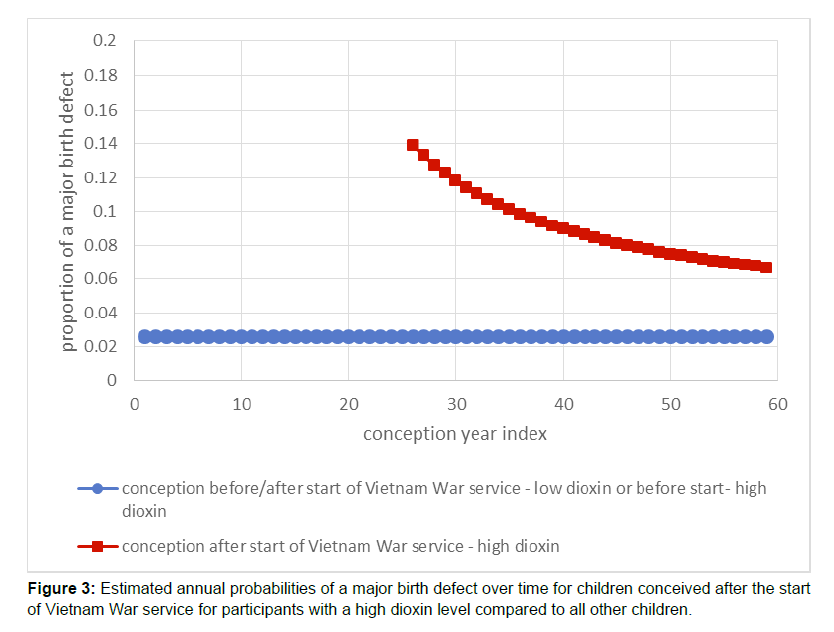
Figure 3: Estimated annual probabilities of a major birth defect over time for children conceived after the start of Vietnam War service for participants with a high dioxin level compared to all other children.
The Occurrence of a Major Birth Defect
Analyses were conducted of the occurrence of a major birth defect for all 6922 live born children fathered by all 2669 participants [10]. These analyses accounted for correlation between data for children of the same participant. First, the impact of conception before versus after the start of Vietnam War service was assessed. The estimated probability of a major birth defect increased from 0.035 for children conceived before the start of Vietnam War service to 0.056 for children conceived after with estimated odds for a major birth defect about 1.6 times larger for children conceived after compared to before. These results supported the conclusion of an adverse Vietnam War service effect on the occurrence of a major birth defect.
Next, an assessment was conducted of whether this Vietnam War service effect can be attributed in part to dioxin exposure using data for 2179 live born children conceived after the start of Vietnam War service for 1153 participants with measured dioxin levels. Since the distribution for dioxin levels was skewed, the natural log of dioxin was used in this analysis. The probability was assumed to be constant up to an adaptively identified threshold and then possibly nonlinearly increasing after that [15-16] [Figure 4]. Displays the estimated probability of a major birth defect as a function of the natural log of dioxin. The estimated probability was constant with value 0.038 up to a threshold of 0.6 and then increased nonlinearly after that up to 0.095. These results supported the conclusion of an adverse effect on the occurrence of a major birth defect due to increased levels of dioxin exposure during Vietnam War service.

Figure 4: Estimated probability of the occurrence of a major birth defect as a function of the natural log of dioxin.
General Categories of Birth Defects and Developmental Disabilities
Analyses were conducted of eight general categories of birth defects and developmental disabilities [10]. Birth defects were categorized as any, multiple, major, and non-major (i.e., either minor or unspecified). Developmental disabilities were categorized as any and multiple. Birth defect and developmental disabilities were categorized as any or both. For each of these eight general categories, the probability increased when conceived after compared to before with estimated odds ranging from about 1.6 to 3.5 times larger for children conceived after compared to before the start of Vietnam War service. These results supported the conclusion of an adverse Vietnam War service effect on the occurrence of all eight available general categories.
An assessment was also conducted of whether these Vietnam War service effects can be attributed in part to dioxin exposure for each of the general categories. As in Figure 4, the probability for each general category was assumed to be constant up to an adaptively identified threshold and then nonlinearly increasing after that. Evidence of a dioxin exposure effect was identified for seven of the eight general categories with thresholds ranging from 0.4 to 1.3. The exception was the occurrence of a non-major birth defect. Plots of estimated relationships were provided for the cases of any birth defect or developmental disability and for any birth defect [10]. Relationships for the two cases of any birth defect or developmental disability and both a birth defect and a developmental disability were step functions as in Figure 5. Relationships for the other five cases followed patterns similar to that of [Figure 4]. These results supported the conclusion of an adverse effect on the occurrence of most general categories of birth defect and developmental disabilities due to increased levels of dioxin exposure during Vietnam War service.
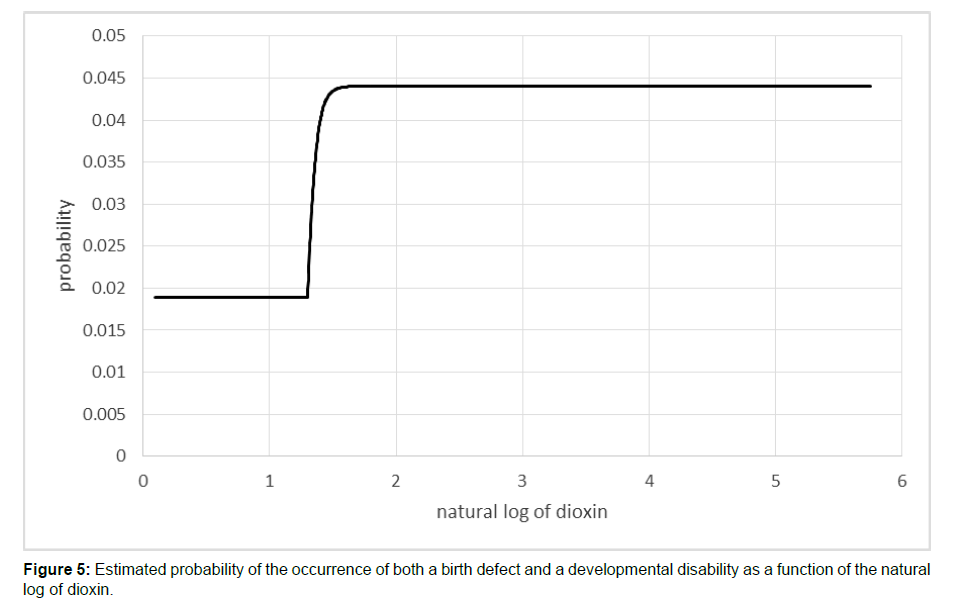
Figure 5: Estimated probability of the occurrence of both a birth defect and a developmental disability as a function of the natural log of dioxin.
Specific Categories of Birth Defects and Developmental Disabilities
Analyses were conducted of 16 specific categories of birth defects and developmental disabilities [11]. Birth defects were categorized as the 12 cases of chromosomal; circulatory; digestive; ear, face, or neck; eye; genital; musculoskeletal; nervous; respiratory; skin; urinary; and other birth defects. Developmental disabilities were categorized as the four cases of developmental delays, emotional disturbance, hyperactivity, and mental retardation. These categories and their names were specified in the AFHS data. They were not as specific as possible. However, most of these specific categories occurred sparsely and so more specific categories would be even more sparse and consequently might not generate reliable analysis results.
Analyses were conducted of the 16 specific categories addressing effects due to dioxin exposure. The analysis process was adjusted due to the sparse occurrence of most specific categories. First, analyses used data for the larger sample of 6374 live born children fathered by 2423 participants. The 2179 live born children conceived after the start of Vietnam War service for the 1153 participants with measured dioxin levels as used in prior analyses were combined with the 4195 live born children conceived before the start of Vietnam War service fathered by 1680 participants. Children conceived before the start of Vietnam War service were treated as having an associated dioxin value below the quantifiable level so that identified low dioxin levels would not be sparse. Second, relationships were assumed to be step functions with low and high levels of the natural log of dioxin identified adaptively (as in the Assessment of the AFHS Conclusion Section). More general nonlinear relationships might not be reliably estimated for sparsely occurring specific categories.
Evidence of an adverse dioxin exposure effect was identified for 15 of the 16 general categories. The exception was the occurrence of the developmental disability category mental retardation. For these 15 specific categories, estimated probabilities increased from a low to a high dioxin level for thresholds ranging from 0.7 to 2.4 with estimated odds ranging from about 2.0 to 6.0 times larger for a high compared to a low dioxin level. These results supported the conclusion of an adverse effect on the occurrence of most specific categories of birth defect and developmental disabilities due to increased levels of dioxin exposure during Vietnam War service.
Conceptions
Analyses were conducted of conceptions addressing the categories of being not live born, a miscarriage, and preterm [12]. The categories of being an induced abortion, a still birth, a tubal pregnancy, and other type of not live born were not considered since they occurred sparsely. For each of the three conception categories, the probability increased when conceived after compared to before the start of Vietnam War service. Estimated probabilities of being not live born, a miscarriage, and preterm increased from 0.130, 0.134, 0.114 for children conceived before the start of Vietnam War service to 0.182, 0.183, and 0.177 for children conceived after with estimated odds about 1.5, 1.5, and 1.7 times larger for children conceived after compared to before. These results supported the conclusion of an adverse Vietnam War service effect on the occurrence of all three conception outcomes.
An assessment was also conducted of whether these Vietnam War service effects can be attributed in part to dioxin exposure for each of the conception categories. As in Figures 4-5, the probability for each conception category was assumed to be constant up to an adaptively identified threshold and then possibly nonlinearly increasing after that. Evidence of a dioxin exposure effect was identified for all three of the conception outcomes. Estimated probabilities of being not live born, a miscarriage, and preterm increased from 0.143, 0.075, and 0.139 at thresholds of 0, 0, and 0.3 to 0.206, 0.159, and 0.231 with increasing natural log of dioxin. Plots for not live born and miscarriage were similar to Figure 4 while the plot for preterm was similar to Figure 5 [12]. These results supported the conclusion of an adverse effect on the occurrence of all three conception outcomes due to increased dioxin exposure during Vietnam War service. However, the adverse dioxin effect on being not live born was primarily driven by the special case of being a miscarriage.
Analysis Issues
Analyses addressing effects due to dioxin exposure were conducted using data for children/conceptions of participants with measured dioxin levels. Results might have changed if dioxin levels had been available for all participants. A sensitivity analysis was conducted addressing this issue using the most inclusive general category of any birth defect or developmental disability and comparing conception before versus after the start of Vietnam War service for the subset of participants with measured dioxin levels [10]. Results of this analysis indicated that this subset of live born children can have a different adverse effect than for live born children of all participants but an adverse effect held for both sets of live born children. These results suggested that a similar conclusion could also hold for analyses of dioxin exposure effects. A sensitivity analysis of the same kind was also conducted using the conception outcome of being not live born with the same conclusion [12]. A sensitivity analysis of a different kind as described later was conducted using each of the 16 specific birth defect and disability category also with the same conclusion [11].
Results reported above were based on analyses not accounting for available covariates. The strength of identified adverse effects might be changed by accounting for such covariates. However, the issue of covariate effects was addressed in two sensitivity analyses [8,12] and covariates were found in those analyses not to have affected conclusions of adverse effects suggesting this could hold more generally.
Dioxin exposures were measured many years after the end of the last Vietnam War tour (i.e., from 9.8 to 30.9 years later), which might have affected analyses addressing adverse effects due to dioxin exposure. However, a sensitivity analysis addressing this issue was conducted [12]. For the special case of a conception being not live born, participants with the same observed dioxin level had worse dioxin effects when associated elapsed times were longer, presumably because the original dioxin exposure would have been larger due to more decay from that original exposure. This result suggests that decay due to elapsed time between exposure and measurement might not have distinctly affected conclusions of dioxin effects in general.
Nonlinear relationships for dependence on natural log of dioxin as in Figures 4-5 were generated assuming those relationships were monotonic, that is, based on a single power transform of natural log of dioxin. However, they might have a more general form, which can be assessed by considering models allowing for multiple power transforms of natural log of dioxin. Using the special case of the outcome not live born, the adaptively generated model allowing for multiple transforms of natural log of dioxin was the same as the model generated restricting to only one such transform [12]. This result indicated that a monotonic relationship was a reasonable assumption for this outcome and so suggested that this conclusion was likely to hold more generally.
Analyses of specific birth defects and developmental disabilities may have been affected by the inclusion of data for children conceived before the start of Vietnam War service. A sensitivity analysis was conducted to assess this issue [11]. The specific category of a musculoskeletal birth defect was the most frequently occurring at 8.1% of the live born children, and so was not sparsely occurring. Analyses of this outcome using the subset of the data of children conceived after the start of Vietnam War service indicated that the threshold, estimated probabilities, and odds changed, but an adverse dioxin exposure effect still held, suggesting this could hold as well for other specific categories.
Support in the literature for adverse effects due to paternal dioxin exposures on reproductive outcomes of Vietnam War veterans, as identified above, is limited [17]. However, Mattison concluded on the basis of a literature review that offspring are vulnerable to several endpoints of developmental toxicity as a consequence of paternal exposures to chemical agents [18] as also supported by Cordier [19].
Analyses might have been influenced by participation. Participants having children with birth defects and developmental disabilities might have been more likely to participate. Participants with higher dioxin exposures might have been more likely to participate. These issues were not assessable. However, identified adverse effects held for substantive numbers of children of AFHS participants, and effects for these veterans seem likely to hold for a more extensive group of Air Force Vietnam War veterans if not for all Vietnam War veterans.
The 877 Ranch Hand participants had quantifiable dioxin levels ranging from 1.33 to 314.2 ppt higher than the 1161 non-Ranch Hand participants with quantifiable dioxin levels ranging from 1.25 to 54.8 ppt. Also, only 10 Ranch Hand participants had dioxin levels below the quantifiable level compared to 105 non-Ranch Hand participants However, for the 1275 children conceived after the start of Vietnam War service for non-Ranch Hand participants with measured dioxin levels, the estimated probability of a major birth defect increased from 0.042 for a low dioxin level (£ 6.3 ppt) to 0.130 for a high dioxin level (> 6.3 ppt) with estimated odds for a major birth defect about 3.4 times larger for a high compared to a low dioxin level. Consequently, dioxin exposure effects were adverse for the non-Ranch Hand participants even though their dioxin exposures were not as large.
Adverse Vietnam War service and dioxin exposure effects for AFHS participants likely generalize to children of other Air Force Vietnam War veterans. Moreover, Vietnam War veterans of other armed services seem likely to have had Vietnam War service experiences and dioxin exposures similar to those for the non-Ranch Hand AFHS participants suggesting that the adverse Vietnam War service and dioxin exposure effects could apply even more generally.
Methods
Reported AFHS results
The AFHS estimated relative risks and tested these using 95% confidence intervals [7]. These analyses controlled for selected covariates.
Assessment of the AFHS conclusion
Analyses conducted to assess the AFHS conclusion addressed the occurrence of multiple birth defects and non-major birth defects as well as major birth defects [8]. Standard generalized estimating equations (GEE) models were used in those analyses. Correlations were estimated assuming an exchangeable correlation structure with the correlation the same for all pairs of children of the same participant (called the intra-class correlation). Probabilities were estimated using logistic regression models. Thresholds for low versus high dioxin levels were identified adaptively using a grid search maximizing the likelihood cross-validation (LCV) score as described later. Changes in the probability from a low to a high dioxin level were tested using Wald c2 tests, standard for GEE analyses, with significance set at p<0.05. Changes were significant for all three birth defect outcomes.
Annual major birth defects over time
Analyses of annual major birth defects over time [8] used extended linear mixed modeling as described later. Correlations were estimated assuming an autoregressive correlation structure with the correlation weakening the further apart measurements were in time. Means for counts of annual major birth defects were estimated using Poisson regression models. An offset variable was used to convert the models for the annual counts to models for associated annual proportions of major birth defects so that means estimated annual probabilities of major birth defects. Alternate models were compared using LCV ratio tests as described later. Nonlinearity of means in time was addressed using fractional polynomials generated adaptively as described later. To generate Figure 2, means were modeled in terms of the two groups of conceived before and after the start of Vietnam War service. Data of this kind are called interrupted time series.
Means were also treated as depending on the four groups of conceived before versus after the start of Vietnam War service each broken down into low versus high dioxin levels using the threshold 6.3 ppt. Means for this four-group model were plotted [8]. The two-group model underlying Figure 3 was a competitive alternative to the four-group model (using an LCV ratio test) and so provided a parsimonious description of the dependence of annual major birth defects on time, conception before versus after, and low versus high dioxin levels.
The occurrence of a major birth defect
Analyses of the occurrence of major birth defects [10] used extended linear mixed modeling. Correlations were estimated assuming an exchangeable correlation structure. Means or probabilities for the occurrence of major birth defects were estimated using logistic regression models. Nonlinearity of means was addressed using fractional polynomials generated adaptively. Alternative models were compared using LCV ratio tests. For example, the relationship of Figure 4 was generated by an adaptive search over alternative thresholds and alternative fractional polynomial models for natural log of dioxin larger than the threshold. The generated model was demonstrated to provide an improvement over the model constant in the natural log of dioxin using an LCV ratio test.
An adjusted categorization of children into conceived before versus after the start of Vietnam War service was used. The prior categorization was, as would be expected, based on whether or not the conception date preceded the start date of the participant's first Vietnam War tour. However, nine children with conception dates after the start of the participant's first tour were conceived before herbicide spraying operations began, and so these children were reclassified as conceived before the start of Vietnam War service since the participant could not have been exposed to herbicide spraying. In effect, the start of Vietnam War service was adjusted to represent the start of Vietnam War service during herbicide spraying operations. This distinction was not addressed in reported analyses for brevity.
General categories of birth defects and developmental disabilities
All eight general categories of birth defects and developmental disabilities were analyzed in the same way as for the occurrence of a major birth defect [10]. LCV ratio tests were used to demonstrate that models for effects to conceived before versus after the start of Vietnam War service and for effects to the natural log of dioxin provided an improvement over the associated constant models.
Specific categories of birth defects and developmental disabilities
Analyses of the 16 specific categories of birth defects and developmental disabilities [11] used extended linear mixed modeling. Correlations were estimated assuming an exchangeable correlation structure. Means or probabilities for the occurrence of the specific categories of birth defects and developmental disabilities were estimated using logistic regression models. Thresholds for low versus high dioxin levels were identified adaptively using a grid search maximizing the LCV score. LCV ratio tests were used to demonstrate that models for effects to low versus high dioxin levels provided an improvement over associated models constant in dioxin.
These analyses did not account for children conceived after the start of Vietnam War service for participants with missing dioxin levels. Not accounting for these children might have had an impact on the conclusions. This issue was assessed in sensitivity analyses by imputing, for these children, proportions of dioxin levels below the quantifiable level and proportions of quantifiable dioxin levels for the occurrence of each specific category. The proportion of dioxin levels below the quantifiable level for these children was imputed using the associated proportion of the children conceived before the start of Vietnam War service for participants with missing dioxin values. The proportion of quantifiable dioxin levels was imputed as the amount that the observed proportion for these children exceeded the imputed proportion of dioxin levels below the quantifiable level. Odds ratios for quantifiable dioxin levels versus dioxin levels below the quantifiable level for both these children as well as the other children were combined into overall odds ratios weighted by subsample sizes. These weighted odds ratios were all larger than 1, ranging from 1.1 to 3.5, suggesting that identified adverse effects were likely not affected by missing data.
Conceptions
All three conception outcomes were analyzed in the same way as the general categories of birth defects and developmental disabilities [12]. LCV ratio tests were used to demonstrate that models for effects to conceived before versus after the start of Vietnam War service and for effects to the natural log of dioxin provided an improvement over the associated constant models.
Extended linear mixed modeling
Standard linear mixed modeling is used to model correlated continuous outcomes treated as normally distributed. Parameters are estimated by maximizing the likelihood based on the multivariate normal density. Extended linear mixed modeling generalizes these methods to categorical outcomes [14]. Means for such outcomes are based on generalized linear models while variances are based on standard functions of the means. For example, the mean m of a dichotomous outcome is determined by the logit transform  and its variance satisfies
 The mean and variance formulas for a categorical outcome are used to evaluate the multivariate normal density, which is treated as a likelihood and maximized to estimate model parameters. It is actually an extended likelihood.
Likelihood cross-validation
The data are randomly partitioned into subsets called folds. Likelihoods are computed for each fold using parameters estimated using all the other data. These deleted likelihoods are normalized by the number of outcome measurements and multiplied to generate the LCV score. Choices of 5 or 10 folds usually generate reliable results. Larger LCV scores indicate better models.
LCV ratio tests
A model with a larger LCV score is not necessarily preferable to a model with a smaller LCV score. This issue is assessed with LCV ratio tests generalizing standard likelihood ratio tests. Models are compared using the percent decrease in the LCV score for the model with the smaller LCV score compared to the LCV score for model with the larger score. A cutoff for a distinct percent decrease is used to determine if a percent decrease is distinct (or substantial or significant). The cutoff decreases with increased numbers of outcome measurements. A percent decrease greater than the cutoff is distinct, indicating that the model with the larger LCV score is distinctly preferable to the model with the smaller LCV score. Otherwise, the model with the lower score is a competitive alternative to the model with the larger LCV score.
The cutoff is computed using the 95th percentile of a c2 test, and so it is reasonable to call a percent decrease greater than the cutoff significant. However, calling a percent decrease distinct or substantial seems better since it avoids controversy about statistical significance. Another reason is that LCV ratio tests are more conservative than standard tests for zero coefficients. For example, the occurrence of a non-major birth defect was significantly related to a high versus low dioxin level using a standard Wald c2 test [8]. However, the model allowing for a possibly nonlinear dependence of this outcome on the natural log of dioxin was not distinctly different from the model constant in the natural log of dioxin using an LCV ratio test [10].
Reported adverse effects to Vietnam War service were established using LCV ratio tests comparing the model for a different effect to conceived before versus after the start of Vietnam War service to the associated constant model. Reported adverse effects to dioxin exposure were established using LCV ratio tests comparing the model assuming dependence on dioxin levels (either as a step function or as a nonlinear function after a threshold) to the associated constant model.
Adaptive regression modeling
Adaptive regression modeling starts by expanding a base model by adding in possibly nonlinear transforms of primary predictors. Continuous primary predictors can be power transformed so that models are based on fractional polynomials, that is, sums of multiple power transforms weighted by slope parameters. The expanded model is then contracted removing power transforms one-at-a-time and adjusting the powers of the remaining transforms. This process is controlled by LCV scores, for example, stopping the contraction is based on an LCV ratio test. An adaptively generated model is an effective choice in the sense that removal of any of its transforms generates a distinct percent decrease in the LCV score. This modeling process is supported by a SAS® macro available upon request from the author. This macro supports adaptive regression modeling for a wide variety of outcomes with measurements treated as independent or as correlated.
Conclusions
In contrast to the conclusion reached by the AFHS using preliminary reproductive outcome data, analyses of a more extensive set of AFHS reproductive outcome data analyzed using more thorough methods led to the following opposite conclusions. Adverse effects due to Vietnam War service were identified for all eight general categories of birth defect and developmental disability outcomes as well as for all three conception outcomes. Also, adverse effects to increased paternal dioxin exposure were identified for seven of the eight general categories and 15 of the 16 specific categories of birth defect and developmental disability outcomes as well as for all three conception outcomes. A wide variety of issues might have affected these analyses.
Acknowledgements
The development of the SAS macro used to generate reported adaptive analyses was supported in part by grants R01 AI57043 from the National Institute of Allergy and Infectious Diseases and R03 MH086132 from the National Institute of Mental Health. This work was not supported by external funding.
References
- https://en.wikipedia.org/wiki/Operation_Ranch_Hand
- https://en.wikipedia.org/wiki/Agent_Orange
- https://en.wikipedia.org/wiki/2,3,7,8-Tetrachlorodibenzodioxin
- Wolfe WH, Michalek JE, Miner JC, Rahe AJ, Silva J, et al. (1990) Health status of Air Force veterans occupationally exposed to herbicides in Vietnam: I. physical health. JAMA 264: 1824-1831.
- https://nap.nationalacademies.org/catalog/20219/the-air-force-health-study-assets-research-program
- Patterson DG, Hampton L, Lapeza CR, Belser WT, Green V, et al. (1987) High-resolution gas chromatographic/high-resolution mass spectrometric analysis of human serum on a whole-weight and lipid basis for 2,3,7,8-tetrachlorodibenzo-p-dioxin. Anal Chem 59: 2000–2005.
- Wolfe WH, Michalek JE, Miner JC, Rahe AJ, Moore CA, et al. (1995) Paternal serum dioxin and reproductive outcomes among veterans of Operation Ranch Hand. Epidemiol 6: 17-22.
- Knafl GJ (2018) A reassessment of birth defects for children of participants of the Air Force Health Study. Open J Epidemiol 8: 187-200.
- Knafl GJ (2022) Adaptive regression for nonlinear interrupted time series analyses with application to birth defects in children of Vietnam. War veterans. Open J Stat 12: 789-809.
- Knafl GJ (2023) An analysis of birth defects and developmental disabilities for children of participants of the Air Force Health Study. Reprod Toxicol 117: 108355.
- Knafl GJ (2024) An analysis of specific categories of birth defects and developmental disabilities for children of participants of the Air Force Health Study. Open J Epidemiol 14: 312-330.
- Knafl GJ (2023) An analysis of reproductive outcomes for conceptions of participants of the Air Force Health Study. Reprod Toxicol 119: 108413.
- Update on Overall Prevalence of Major Birth Defects-Atlanta, Georgia, 1978--2005 (cdc.gov)
- Knafl GJ (2023) Modeling correlated outcomes using extensions of generalized estimating equations and linear mixed modeling. Springer Nature Switzerland AG, Switzerland.
- Brent RL (2001) Addressing environmentally caused human birth defects. Pediatr Rev 22: 147–179.
- Roberts L (1991) Dioxin risks revisited. Science 251: 624–626.
- Veterans and Agent Orange: update 11 (2018). National Academies Press, Washington, DC.
- Mattison DR (2010) Environmental exposures and devel Curr Opin Pediatr 22: 208–218.
- Cordier S (2007) Evidence for a role of paternal exposures in developmental toxicity. Basic Clin Pharmacol Toxicol 102: 176–181.
Citation: Knafl GJ (2025) Adverse Effects on Reproductive Outcomes for Male Vietnam War Veterans. Toxicol Open Access 11: 338.
Copyright: © 2025 Knafl GJ. This is an open-access article distributed under the terms of the Creative Commons Attribution License, which permits unrestricted use, distribution, and reproduction in any medium, provided the original author and source are credited.
Select your language of interest to view the total content in your interested language
Share This Article
Open Access Journals
Article Usage
- Total views: 107
- [From(publication date): 0-0 - Dec 09, 2025]
- Breakdown by view type
- HTML page views: 78
- PDF downloads: 29
