
Clinical and Consumer Studies of a Novel Custom-Fit, Full-Mouth Toothbrush
Received: 03-Oct-2025 / Manuscript No. johh-25-171614 / Editor assigned: 06-Oct-2025 / PreQC No. johh-25-171614 (PQ) / Reviewed: 16-Oct-2025 / QC No. johh-25-171614 / Revised: 20-Oct-2025 / Manuscript No. johh-25-171614 (R) / Published Date: 30-Dec-2025
Abstract
Objectives: To assess consumer acceptance of a custom-fit, full-mouth power toothbrush and to evaluate its abilityto reduce dental plaque, gingival bleeding, inflammation, and recession as compared to a manual toothbrush.
Methods: Adults (n=101) participated in a consumer research study of the ZERObrush power toothbrush (ZBPT)in which they used the ZBPT for 2 weeks and subsequently completed a survey. Sixty-three subjects were enrolled ina examiner-blind, randomized, parallel design 4 week clinical study conducted at a single center. Subjects started thestudy with a 1week washout period using a manual toothbrush (MTB), after which they were randomized to one of twotreatments: ZBPT for 30 s per brushing or MTB for 60 s per brushing. Efficacy and safety evaluations were conductedat baseline and at 4 weeks, in which plaque, gingival inflammation, bleeding and recession were assessed.
Results: At baseline both treatments resulted in within-group reductions from pre-brushing to post-brushingthat were statistically significant (p<0.0001). There was a 54.8% reduction in the overall plaque score for the ZBPTgroup and a 29.9% reduction in the MTB group. The between-group treatment difference was statistically significant(p<0.0001). Examining the plaque scores at 4 weeks showed that the ZBPT group returned with statistically significantlylower plaque scores from baseline whereas there was no statistically significant reduction in the plaque scores inthe MTB group. This between-group treatment difference was statistically different (p=0.0243). The change in scorefrom baseline to week 4 for both bleeding and inflammation showed the between-group treatment differences werestatistically significant (p=0.0012, p<0.001; respectively). Although the recession measures trended lower for bothgroups, the changes from baseline were not statistically significant.
Conclusion: The ZERObrush powered toothbrush was statistically superior to the manual toothbrush in reducingdental plaque, gingival inflammation and bleeding following 4 weeks’ home use. Both products tested were found tobe safe.
Keywords
Oral Hygiene; Dental Plaque; Gingival Health; Tooth brushing; Customized Home Care
Introduction
Oral health-related quality of life is an integral part of general health and well-being. Good oral hygiene contributes to improved quality of life by reducing oral pain, preventing disease progression, and supporting overall physical and psychosocial well-being [1-3]. Poor oral health has been linked not only to dental caries and periodontal disease but also to systemic conditions such as cardiovascular disease, diabetes, and adverse pregnancy outcomes [4, 5]. Maintaining effective oral hygiene practices reduces the microbial burden in the oral cavity and lowers the occurrence of dental diseases [6]. Oral hygiene typically includes the use of a toothbrush and toothpaste; however, the effectiveness of oral hygiene practices depends on patient compliance, manual skill and motivation.
Tooth brushing is consistently characterized by uneven distribution of brushing time across tooth surfaces. Studies have shown that individuals spend a disproportionate amount of time brushing the buccal surfaces of the maxillary anterior teeth [7, 8]. Dental professionals recommend brushing for 2 minutes, twice a day. However, observation of brushing behavior suggests brushing occurs for less than 1 minute [9, 10].These findings with respect to uniformity and duration of brushing underscore the importance of oral hygiene instruction and technological interventions designed to promote balanced brushing [11].
Recent advances in technology provide the opportunity to create a unique oral hygiene device specific to each user. Intraoral scans that are now common in dental offices provide accurate three-dimensional representations of the dentition. The combination of these scans with 3D printing allows the generation of a device that conforms closely to the tooth surface. ZERO brush Inc. has utilized these technological advances to create a full-mouth power toothbrush with a mouthpiece that is custom fit to the dental anatomy of each user. The objective of this study is to evaluate the clinical performance of ZERO brush’s device in comparison to a manual toothbrush and to gain consumer insight into its acceptance.
Materials and Methods
This comprehensive evaluation of a ZERO brush full-mouth power toothbrush (ZBPT) with a custom-fit mouthpiece consisted of both a consumer research study that evaluated the toothbrush’s consumer acceptance and a clinical study that evaluated its efficacy and safety.
Consumer Research Study
The consumer research study was a 2-week home-use test placed from a central location (Various Views Research, Blue Ash, OH) using 101 adult individuals who expressed positive purchase intent to the ZBPT concept and did not meet any study exclusion criteria. Qualifying individuals obtained a full-mouth digital scan of their dentition. This scan was used to create a toothbrush mouthpiece unique to the participant. When the mouthpiece was complete, participants picked up their ZBPT test kit which included the custom mouthpiece, a handle, a charging stand, a quick-start guide, one tube of toothpaste (Crest 3DWhite, Procter & Gamble, Cincinnati OH USA), and a Snap-On toothpaste dispensing cap to aid application of the toothpaste to the mouthpiece. Participants unboxed, assembled, and turned on their ZBPT at the research facility. After 14-days of in-home use, participants completed an online survey about their experience.
Clinical Study
The clinical study was a prospective, randomized, examiner-blind, 2-arm parallel, 4-week evaluation of efficacy and safety of two oral hygiene devices. The study was approved by an accredited IRB (Sterling IRB, Atlanta GA, and IRB00001790) and executed at a single site (Complete Health Dentistry, Blue Ash OH). All subjects were recruited from the pool of participants in the previously mentioned consumer research study and thus had the ZBPT custom-fit mouthpiece previously made. The primary objectives of this study were the evaluations of dental plaque reduction and device safety. Secondary objectives included the evaluation of gingival health and recession after 4-weeks of in-home use.
The number of subjects was based on a parallel design study assuming a difference in the plaque score of 0.30 between the two toothbrushes and a common standard deviation of 0.40. A sample size of 56 subjects (28 per treatment group) was calculated to provide 80% power to detect a statistically significant difference in reduction in the plaque score with a significance level 0.05 using a two-sided two-sample equal-variance t-test. Due to possible attrition, up to 32 subjects in each group were planned for enrollment.
The study contained 3 subject visits to the dental clinic. During the first visit subjects were screened for enrollment criteria and consented. Enrollment criteria included a willingness to abide by study oral hygiene requirements, overall good general health, and evidence of mild to moderate plaque buildup without significant calcification. Exclusion criteria included significant decay, periodontal disease or active orthodontic treatment. Subjects who were enrolled received a manual toothbrush and toothpaste for a 7-day washout period before the Baseline visit.
At the Baseline visit (Visit 2) subjects were randomization to one of two treatment groups: ZBPT group = ZERO brush use for 30 s, or MTB group = manual toothbrush use for 60 s. Subjects received an oral exam, a full mouth digital scan (iTero Lumina, Tempe AZ, USA), a gingival bleeding assessment [12], measurement of gingival recession, and pre- and post-brushing plaque assessments using the Turesky Modified Quigley Hein Plaque Index [13]. Between the pre- and post-brushing assessments the subjects used their assigned oral hygiene device. Subjects returned for a post-use clinical evaluation (Visit 3) after using their assigned device at home for a 4-week period. Adverse events based on the oral exam and patient reporting were recorded at each Visits 2 and 3 to assess safety.
The plaque scores for each subject were analyzed to obtain mean subject plaque scores for both the whole mouth (overall) and sub regions of the dentition. The analysis yielded a pre-brushing mean plaque score and post-brushing mean plaque score for each subject using their assigned device. A percent reduction between the pre-brushing plaque score and the post-brushing plaque score was calculated for each subject and subsequently used to determine group averages for each device. A single-factor ANOVA was used to test for statistically significant treatment differences between the two groups. Similarly, changes in plaque levels were analyzed between the Baseline and Week 4 visits for both pre- and post-brushing scores. Gingival bleeding and recession measures were scored by the examiner during the clinical visit whereas the inflammation measure [14] was scored after the visit from the scanned images of the dentition and gingiva. Changes in bleeding, inflammation and recession were analyzed between the Baseline and Week 4 visits. A single-factor ANOVA was used to test for statistically significant treatment differences between the two groups’ change scores from baseline.
Results
Consumer Research Study
One hundred one participants completed the consumer research study. The average age of participants was 48.9 years (range: 23-70, SD = 11.27). There were 85 females (84.2%) and 16 males (15.8%) who participated. At the conclusion of the 14-day home use, 66% of participants rated ZBPT better than any toothbrush they had ever used, and 89% wanted to continue to use it. Attribute-level results include: 74% agreed ZBPT delivered a superior clean feeling every day; 76% agreed it was a gentle, comfortable brushing experience; 75% agreed it is the most effortless way to brush; and 73% agreed it simplifies their brushing routine.
Clinical Study
The clinical study demographic data for all enrolled subjects are presented in [Table 1]. The average age for all study participants was 47.9 years with a gender composition of 84.1% female and 19.9% male. There was no statistical difference between the ZBPT and MTB groups for either age or gender. Sixty-three subjects completed the Baseline visit (n=32 in the ZBPT group and n=31 in the MTB group). By the Week 4 visit there remained one subject fewer in each group: one lost to follow-up and the other to study non-compliance.
| Variable | Category | ZBPTa | MTBa | Total | p-valueb |
|---|---|---|---|---|---|
| (N=32) | (N=31) | (N=63) | |||
| Age (years) | Mean (SD) | 48.2 (9.45) | 47.5 (11.27) | 47.9 (10.30) | 0.7892 |
| Min, Max | 23, 61 | 27,70 | 23,70 | ||
| Gender | Female | 27 (84.4%) | 26 (83.9%) | 53 (84.1 %) | 0.9564 |
| Male | 5 (15.8%) | 5 (16.1%) | 10 (15.9%)) |
(A): ZBPT = ZERO brush power toothbrush; MTB = Manual toothbrush
(B): p-value is based on one-way ANOVA for continuous variables and Chi-squared test for categorical variables
Table 1: Clinical Study Demographic Characteristics: All Randomized Subjects
Summary plaque removal data for the single brushing event is presented in [Table 2] for the Baseline visit for the two treatment groups. There were no statistical differences in the overall pre-brushing plaque levels between the two groups (p=0.5000) nor for any of the sub-regions (p>0.22) at Baseline. For both treatments the within-group reduction from pre-brushing to post-brushing was statistically significant (p<0.0001). There was a 54.8% reduction in the plaque score for the ZBPT group from pre-brushing to post-brushing and a 29.9% reduction in the MTB group. The between-group treatment difference was statistically significant (p<0.0001) with the ZBPT group demonstrating greater plaque removal [Figure 1]. Shows a graphical representation of the overall result along with the results for the sub regions examined. The percentage plaque reduction in the various subregions within the ZBPT group ranged from 47% to 61% and within the MTBPT group ranged from 7% to 45%. The ZBPT group demonstrated statistically significant greater plaque reduction in all subregions (p<0.0001).
| Visit | Outcomea | Statistica | ZBPTa | MTBa | Treatment Differenceb | p-valuec |
|---|---|---|---|---|---|---|
| (N=32) | (N=31) | |||||
| Overall dentition | ||||||
| Pre-Brushing | Plaque Score | Mean (SE) | 2.41 (0.090) | 2.31 (0.114) | 0.1 | 0.5 |
| Post-Brushing | Plaque Score | Mean (SE) | 1.09 (0.075) | 1.59 (0.094) | -0.5 | <0.0001 |
| PCPP | Mean (SE) | 54.8% (2.4%) | 29.9% (3.1%) | 24.90% | <0.0001 | |
| (A): Abbreviations: PCPP = Percent change pre-brushing to post-brushing, SE = Standard error, ZBPT = ZERO brush power toothbrush, MTB = Manual toothbrush (B): Treatment difference = ZBPT minus MTB (C) p-value for Treatment Difference, based on analysis of variance |
||||||
Table 2: Baseline Plaque Results: Pre- and Post-brushing
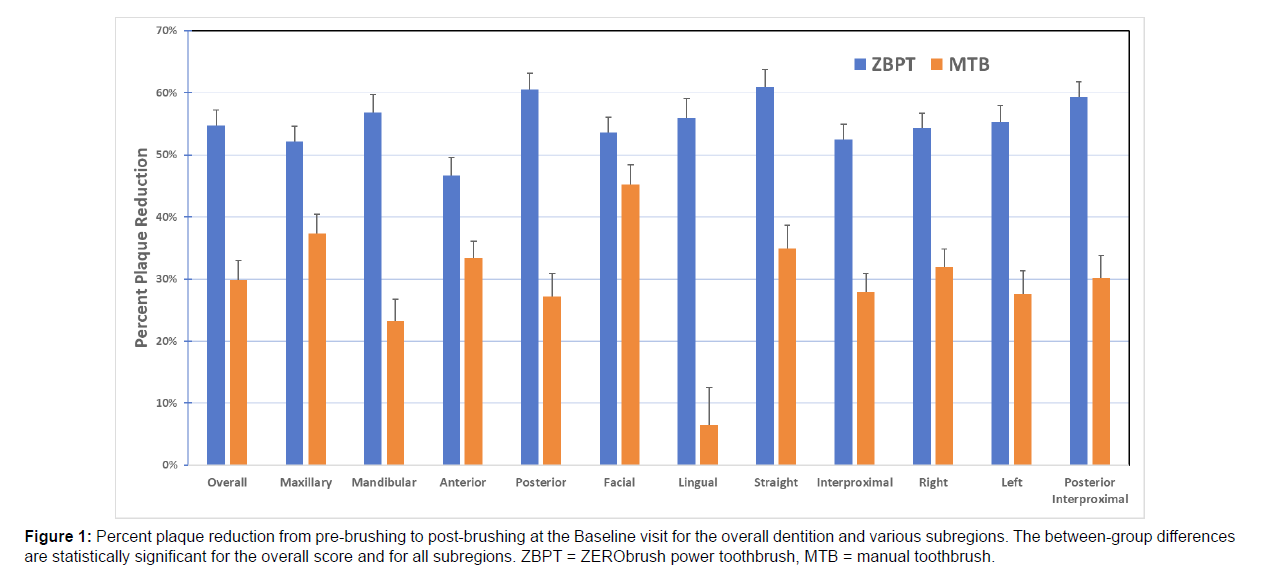
Figure 1: Percent plaque reduction from pre-brushing to post-brushing at the Baseline visit for the overall dentition and various subregions. The between-group differences are statistically significant for the overall score and for all subregions. ZBPT = ZERObrush power toothbrush, MTB = manual toothbrush.
A comparison of plaque scores at Baseline and Week 4 is presented in [Table 3]. Examining the within-group pre-brushing plaque scores showed that the ZBPT group returned at Week 4 with statistically significantly lower plaque scores than at baseline whereas there was no statistically significant reduction in the plaque scores in the MTB group. For pre-brushing scores, the ZBPT group showed a 0.39 reduction compared to a 0.07 score reduction in the MTB group. This between-group treatment difference was statistically significantly different (p=0.0243). Examining the post-brushing plaque scores showed that at both Baseline and Week 4 the ZBPT group has lower plaque levels than the MTB group, with the between group treatment difference being statistically significant (p=0.0002, p=0.0005; respectively).
| Visit | Outcome | Statistica | ZBPTa | MTBa | Treatment Differenceb | p-valuec |
|---|---|---|---|---|---|---|
| (N=31) | (N=30) | |||||
| Pre-Brushing Scores | ||||||
| Baseline | Plaque Score | Mean (SE) | 2.41 (0.093) | 2.32 (0.118) | 0.09 | 0.5525 |
| Week 4 | Plaque Score | Mean (SE) | 2.02 (0.106) d | 2.25 (0.106) | -0.23 | 0.1271 |
| Change in Score | Mean (SE) | 0.39 (0.100) | 0.07 (0.097) | 0.32 | 0.0243 | |
| Post-Brushing Scores | ||||||
| Baseline | Plaque Score | Mean (SE) | 1.11 (0.074) | 1.60 (0.097) | -0.49 | 0.0002 |
| Week 4 | Plaque Score | Mean (SE) | 1.09 (0.098) | 1.54 (0.075) | -0.45 | 0.0005 |
| Change in Score | Mean (SE) | 0.02 (0.076) | 0.05 (0.077) | 0.32 | 0.7848 | |
| (A): Abbreviations: SE = Standard error, ZBPT = ZERO brush power toothbrush, MTB = Manual toothbrush (B): Treatment difference = ZBPT minus MTB (C): p-value for Treatment Difference, based on analysis of variance (D): Statistically significant reduction from Baseline to Week 4 based on analysis of variance, p=0.0080 |
||||||
Table 3: Plaque Score Changes from Baseline to Week 4
Changes in gingival bleeding and inflammation from Baseline to Week 4 are presented in [Table 4]. There was no statistically significant difference in the gingival bleeding or inflammation scores between the two groups at Baseline. However, at Week 4 both the bleeding and inflammation scores were trending downward in the ZBPT group but trending upward in the MTB group, indicating that the ZBPT group’s gingival health was improving while the MTB group’s gingival health was worsening. Examining the change in score from Baseline to Week 4 for both bleeding and inflammation showed the between-group treatment differences were statistically significant (p=0.0012, p<0.0001; respectively).
| Visit | Outcome | Statistica | ZBPTa | MTBa | Treatment Differenceb | p-valuec |
|---|---|---|---|---|---|---|
| (N=31) | (N=30) | |||||
| Bleeding (0= No Bleeding, 1 = Bleeding) -Data Expressed As Percentage Of Sites With Bleeding | ||||||
| Baseline | Bleeding Score | Mean (SE) | 4.87% (1.23%) | 7.34% (1.50%) | -2.47% | 0.2056 |
| Week 4 | Bleeding Score | Mean (SE) | 3.52% (0.80%) | 12.16% 2.09%) | -8.64% | 0.0002 |
| Change in Score | Mean (SE) | 1.35% (0.98%) | -4.82%(1.54%) | 6.17 | 0.0012 | |
| Inflammation (0 To 4 Scale) – Data Expressed As Average Inflammation Score For All Sites | ||||||
| Baseline | Inflammation Score | Mean (SE) | 0.203 (0.029) | 0.185 (0.028) | 0.018 | 0.6635 |
| Week 4 | inflammation Score | Mean (SE) | 0.140 (0.025) | 0.383 (0.045) d | -0.243 | <0.0001 |
| Change in Score | Mean (SE) | 0.063 (0.014) | -0.197 (0.038) | 0.26 | <0.0001 | |
| (A): Abbreviations: SE = Standard error, ZBPT = ZERO brush power toothbrush, MTB = Manual toothbrush (B): Treatment difference = ZBPT minus MTB (C): p-value for Treatment Difference, based on analysis of variance (D): Statistically significant change from Baseline to Week 4 based on analysis of variance, p<0.0005 |
||||||
Table 4: Gingival Bleeding and Inflammation Changes from Baseline to Week 4
Changes in gingival recession from Baseline to Week 4 are presented in [Table 5]. Only the 57 subjects who had recession at either visit were included in the analysis (N=30 in the ZBPT group, N=27 in the MTB group). There was no statistically significant difference in the recession measures between the two groups at Baseline. Although the recession measures trended lower for both groups, the changes from Baseline were not statistically significant.
| Visit | Outcome | Statistica | ZBPTa | MTBa | Treatment Differenceb | p-valuec |
|---|---|---|---|---|---|---|
| (N=30) | (N=27) | |||||
| Recession (Measured In Mm) – Data Expressed As Average Recession Measure For All Sites With Recession | ||||||
| Baseline | Recession Measure | Mean (SE) | 1.44 (0.046) | 1.58 (0.063) | -0.14 | 0.0697 |
| Week 4 | Recession Measure | Mean (SE) | 1.32 (0.040) | 1.47 (0.059) | -0.15 | 0.0438 |
| Change in Score | Mean (SE) | 0.12 (0.031) | 0.11 (0.041) | 0.01 | 0.9545 | |
| NOTE: Subjects who had no recession at either visit were not included in the analysis (A): Abbreviations: SE = Standard error, ZBPT = ZERO brush power toothbrush, MTB = Manual toothbrush (B): Treatment difference = ZBPT minus MTB (C): p-value for Treatment Difference, based on analysis of variance |
||||||
Table 5: Recession Changes from Baseline to Week 4
There were no adverse events reported in the study.
Discussion and Conclusions
ZBPT is a full-mouth power toothbrush with a custom-fit mouthpiece that removes dental plaque and debris from the surfaces of teeth. The ZBPT handle vibrates the mouthpiece, activating cleaning tips to gently scrub the tooth surfaces. Examinations of the single-brushing plaque removal results from this study indicate that use of the ZBPT resulted in a statistically significant superior level of plaque removal as compared to use of the MTB. Use of the ZBPT also resulted in less plaque remaining on the surfaces of the teeth after 4 weeks of use as compared to the MTB. Further, the study indicates that ZBPT use resulted in a more even level of plaque removal throughout the mouth than the use of the MTB. These results demonstrate a significant oral hygiene benefit to ZBPT users and are likely to be due to the customized fit of the mouthpiece and uniform surface coverage of the complete dentition during brushing.
For a novel toothbrush to be routinely used as part of daily oral hygiene, a high level of user acceptance is preferred. The results of the consumer research presented here show that the participants found the ZBPT to be desirable with 89% wanting to continue using it as it delivered a superior clean feeling. Users commented on how the custom-fit mouthpiece “hugs every tooth surface” providing “gentle gum care” and “confidence that every tooth is thoroughly cleaned every time”. Participants noted the “quick, thorough cleaning” made them less likely to skip brushing sessions.
Research shows that manual toothbrush users distribute brushing time unevenly across different areas of the mouth. People tend to spend more time brushing the buccal surfaces of the anterior teeth and less time on lingual surfaces, especially in posterior regions. This uneven brushing may lead to plaque accumulation on unbrushed surfaces with resulting higher levels of calculus formation and gingival inflammation. ZBPT brushes dental surfaces evenly by contacting all accessible surfaces at once. The ZBPT user no longer needs to be concerned about uniformly moving the toothbrush throughout the mouth. The results of this study, particularly as shown in [Figure 1], demonstrate that ZBPT use provides superior plaque removal in all sub regions of the dentition.
Dental professionals recommend brushing for 2 minutes twice a day, but MTB users often spend a minute or less per brushing. Assuming the average brusher has 28 teeth with 3 accessible brushing surfaces per tooth (facial, lingual, occlusal) and assuming the typical MTB brushes 3-4 surfaces at a time, a 60 second MTB brushing results in approximately 2-3 seconds of brushing spent on any given surface. During ZBPT use, each tooth surface receives 30 seconds of brushing. Reduced amount of time needed to brush one’s teeth and concurrent uniform dental plaque throughout the mouth can be strong motivators for regular oral hygiene.
This study showed that 4 weeks of ZBPT use provided superior bleeding and gingival inflammation reduction as compared to the MTB. As this was primarily a dental plaque reduction study and subjects were not selected based on these gingival health indices, the resulting subject scores were rather low at baseline. The reduction in bleeding and inflammation with the ZBPT is expected based on the reduction in plaque over the 4-week period. The increases in bleeding and inflammation within the MTB group suggest that the level of daily plaque removal with the MTB was insufficient to prevent a trend towards worsening gingival health.
The results of this study suggest that ZERO brush was well accepted by users and that the use of ZERO brush for 30 seconds provides superior removal of dental plaque and improvements in gingival health as compared to the use of a manual toothbrush for 60 seconds.
References
- Haag DG, Peres KG, Balasubramanyam M, Brennan DS (2017) Oral Conditions and Health-Related Quality of Life: A Systematic Review. J Dent Res 96: 864-874.
- Van de Rijt LJM, Stoop CC, Weijenberg RAF (2020) The influence of oral health factors on the quality of life in older people: A systematic review. Gerontologist 60: e378-e394.
- Sischo L, Broder HL (2011) Oral health-related quality of life: what, why, how, and future implications. J Dent Res 90: 1264-1270.
- Tonetti MS, Van Dyke TE (2013) Working group 1 of the joint EFP/AAP workshop. Periodontitis and atherosclerotic cardiovascular disease: consensus report of the Joint EFP/AAP Workshop on Periodontitis and Systemic Diseases. J Clin Periodontal 14: S24-29.
- Sanz M, Marco Del Castillo A, Jepsen S (2020) Periodontitis and cardiovascular diseases: Consensus report. J Clin Periodontol 47: 268-288.
- Van der Weijden F, Slot DE (2011) Oral hygiene in the prevention of periodontal diseases: the evidence. Periodontol 2000 55: 104-123.
- Rugg-Gunn AJ, Macgregor ID (1978) A survey of toothbrushing behaviour in children and young adults. J Periodontal Res 13: 382-389.
- Harnacke D, Winterfeld T, Erhardt J (2015) what is the best predictor for oral cleanliness after brushing? Results from an observational cohort study. J Periodontol 86: 101-107.
- Macgregor ID, Rugg-Gunn AJ (1985) Tooth brushing duration in 60 uninstructed young adults. Community Dent Oral Epidemiol 13: 121-122.
- Creeth JE, Gallagher A, Sowinski J, Bowman J, Barrett K, et al. (2009) The effect of brushing time and dentifrice on dental plaque removal in vivo. J Dent Hyg 83: 111-116.
Indexed at, Google scholar, Cross ref
- Van der Weijden GA, Hioe KP (2005) A systematic review of the effectiveness of self-performed mechanical plaque removal in adults with gingivitis using a manual toothbrush. J Clin Periodontol 6: 214-228.
- Van der Weijden GA, Timmerman MF, Nijboer A, Reijerse E, Van der Velden U (1994) Comparison of different approaches to assess bleeding on probing as indicators of gingivitis. J Clin Periodontol 21: 589-894.
- Turesky S, Gilmore ND, Glickman I (1970) Reduced plaque formation by the chloromethyl analogue of victamine C. J Periodontol 41: 41-43.
- Lobene RR, Weatherford T, Ross NM, Lamm RA, Menaker L (1986) A modified gingival index for use in clinical trials. Clin Prev Dent 8: 3-6.
Citation: Eric Henize DDS, Holly Leonard RDH, Molly Findley BS (2025) Clinical and Consumer Studies of a Novel Custom-Fit, Full-Mouth Toothbrush J Oral Hyg Health 13: 514.
Copyright: © 2025 Eric Henize DDS, et al. This is an open-access article distributed under the terms of the Creative Commons Attribution License, which permits unrestricted use, distribution, and reproduction in any medium, provided the original author and source are credited.
Select your language of interest to view the total content in your interested language
Share This Article
Recommended Journals
Open Access Journals
Article Usage
- Total views: 163
- [From(publication date): 0-0 - Dec 02, 2025]
- Breakdown by view type
- HTML page views: 132
- PDF downloads: 31
