
Parkinsonism its Diagnosis the Role of Biosensors and Biomarkers: A Case Report
Received: 03-May-2024 / Manuscript No. JADP-24-133984 / Editor assigned: 06-May-2024 / PreQC No. JADP-24-133984 (PQ) / Reviewed: 21-May-2024 / QC No. JADP-24-133984 / Revised: 13-Mar-2025 / Manuscript No. JADP-24-133984 (R) / Published Date: 20-Mar-2025
Abstract
Parkinsonism presents a diagnostic challenge due to its heterogeneous clinical manifestations, which often overlap with other neurological conditions. We present a case report of a 65-year-old male with progressive bradykinesia, rigidity and tremor, raising suspicion for Parkinson's Disease (PD). However, a comprehensive evaluation led to the diagnosis of Vascular Parkinsonism (VP) based on clinical findings, neuroimaging and response to treatment. This case highlights the importance of a thorough differential diagnosis in Parkinsonism and underscores the role of neuroimaging in distinguishing between idiopathic PD and secondary Parkinsonian syndromes.
Keywords: Parkinsonism; Vascular parkinsonism; Differential diagnosis; Neuroimaging; Small vessel disease
Keywords
Parkinsonism; Vascular parkinsonism; Differential diagnosis; Neuroimaging; Small vessel disease
Introduction
Parkinsonism encompasses a spectrum of neurological disorders characterized by motor symptoms such as bradykinesia, rigidity, tremor and postural instability. Parkinson's Disease (PD) represents the most common form of parkinsonism, accounting for approximately 85% of cases. However, numerous other conditions, including Vascular Parkinsonism (VP), Multiple System Atrophy (MSA) and Progressive Supranuclear Palsy (PSP), can present with similar clinical features, posing diagnostic challenges for clinicians.
Challenges in electrochemical impedance spectroscopy
Electrochemical impedance spectroscopy is a valuable tool for researchers, however, it presents challenges in conducting experiments and analyzing data. One of the challenges is determining a suitable equivalent circuit to represent the electrochemical system under investigation [1- 3]. An equivalent circuit is a reduced model of a system that enables for electrical behavior. Choosing the proper equivalent circuit can be difficult since it necessitates an in-depth understanding of the electrochemical processes and phenomena at work in the system. Another problem is determining the most suitable formalisms for data analysis. Formalisms are mathematical and analytical methodologies for extracting significant information from impedance spectroscopy data. Depending on the system and information needed, several formalisms may be required. Fitting experimental data to equivalent circuit models, for example, might give significant insights, although advanced computational approaches may be required for complex data sets. Because of the complexity of electrochemical processes and the unreliability of simple equivalent circuit models, interpreting impedance data may be difficult. To guarantee reliable data analysis and interpretation, researchers must employ proper approaches. This review suggests solutions for impedance analysis challenges, including refined equivalent circuit models, advanced data analysis formalisms and simulation-based methods. These methods aim to improve the accuracy and reliability of impedance analysis, enabling researchers to gain a deeper understanding of the electrochemical system under investigation. Other solutions include advancements in measurement techniques, data processing and machine learning algorithms. These methods can enhance the accuracy of impedance analysis and extract valuable insights from complex datasets.
Parkinson's disease biomarkers
In recent years, progress has been made to optimize the diagnostic process of PD, particularly through the identification of fluid biomarkers. A key pathological hallmark of PD is defined by the aggregation of α-synuclein leading to the development of Lewy pathology. Although the normal function of this protein is not completely understood, its location in the pre-synaptic nerve terminals suggests that α-synuclein might have an important function in vesicle trafficking in nerve terminals [4].
Parkinson's disease biosensors
Most of the studies were able to detect and quantify very low levels of α-synuclein related biomarkers, attaining commercial available products such as Enzyme Linked Immuno Sorbent Assay (ELISA) [5,6]. This dynamic makes them excellent candidates for the development of diagnostic tools capable of performing accurate determination of this biomarker in more accessible biological fluids, such as blood, where the levels of this biomarker tend to be ten to one hundred times [5].
Case Presentation
A 65-year-old male presented with a two-year history of progressive slowness of movement, stiffness and tremor predominantly affecting his right hand. His symptoms had gradually worsened, impairing his activities of daily living. He denied any family history of neurodegenerative disorders or exposure to neurotoxins. Neurological examination revealed bradykinesia, cogwheel rigidity and a resting tremor in the right upper limb. He displayed a shuffling gait with reduced arm swing on the right side. Cognitive function assessed by the Mini-Mental State Examination (MMSE) was within normal limits (Figure 1) [6].
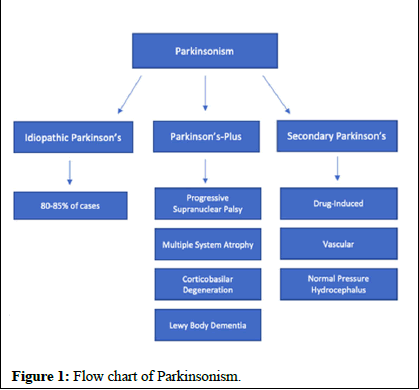
Figure 1: Flow chart of Parkinsonism.
Given the classical motor symptoms and absence of atypical features, the initial diagnosis of idiopathic PD was considered. However, further investigation was warranted to rule out secondary causes of Parkinsonism. Laboratory tests, including complete blood count, metabolic panel, thyroid function tests and serum ceruloplasmin levels, were unremarkable. Brain Magnetic Resonance Imaging (MRI) revealed multiple lacunar infarcts in the basal ganglia and periventricular white matter, consistent with small vessel disease [7].
Discussion
The clinical presentation of Parkinsonism can be heterogeneous and accurate diagnosis requires a systematic approach. While PD is the prototypical cause of Parkinsonian symptoms, secondary parkinsonian syndromes should be considered, particularly in the presence of atypical features or red flags. VP, characterized by vascular lesions affecting the basal ganglia and white matter, represents a common secondary cause of Parkinsonism, often resulting from cerebrovascular disease or small vessel pathology [8].
Neuroimaging plays a crucial role in distinguishing between idiopathic PD and secondary parkinsonian syndromes. In our case, MRI findings of multiple lacunar infarcts suggested a vascular etiology, supporting the diagnosis of VP. Treatment strategies for VP primarily focus on managing vascular risk factors and optimizing rehabilitation to improve gait and mobility. Dopaminergic medications may provide symptomatic relief but are often less effective compared to PD [9].
Conclusion
Parkinsonism poses diagnostic challenges due to its varied etiologies and overlapping clinical features. A comprehensive evaluation, including detailed history-taking, neurological examination and neuroimaging, is essential for accurate diagnosis and appropriate management. This case underscores the importance of considering secondary causes of Parkinsonism, such as VP, particularly in patients with vascular risk factors or atypical clinical features. Further research is needed to elucidate the pathophysiology of VP and optimize treatment strategies for this condition.
Declaration of Competing Interest
The authors declare that they have no known competing financial interests or personal relationships that could have appeared to influence the work reported in this paper.
References
- Kulisevsky J, Nakajima Y, Kronfeld N, King S, Mori A (2023) Effect of istradefylline dosage on unified Parkisons’ disease rating scale (UPDRS) III-ON scores: results from four randomized clinical trials. Neurol Res 23: 113.
[Crossref] [Google Scholar] [PubMed]
- Fernández-Seara MA, Mengual E, Vidorreta M, Aznárez-Sanado M, Loayza FR, et al. (2012) Cortical hypoperfusion in Parkinson's disease assessed using arterial spin labeled perfusion MRI. Neuroimage. 59: 2743-2750.
[Crossref] [Google Scholar] [PubMed]
- Cubo E, Doumbe J, Njiengwe E, Onana P, Garoña R, et al. (2015) A Parkinson's disease tele-education program for health care providers in Cameroon. J Neurol Sci 357: 285-287.
[Crossref] [Google Scholar] [PubMed]
- Menza MA, Rosen RC (1995) Sleep in Parkinson's disease: The role of depression and anxiety. Psychosomatics 36: 262-266.
[Crossref] [Google Scholar] [PubMed]
- Caviness JN (2012) Presymptomatic Parkinson's disease: The Arizona experience. Parkinsonism Relat Disord 18: 203-206.
[Crossref] [Google Scholar] [PubMed]
- Benabid AL (2000) Deep brain stimulation for Parkinson’s disease. N Engl J Med 13: 696-706.
[Crossref] [Google Scholar] [PubMed]
- Scherfler C, Schwarz J, Antonini A, Grosset D, Valldeoriola F, et al. (2007) Role of DAT‐SPECT in the diagnostic work up of parkinsonism. 22: 1229-1238.
- Rajput AH, Rozdilsky BL, Rajput A (1991) Accuracy of clinical diagnosis in parkinsonism a prospective study. Can J Neurol Sci 18: 275-278.
- Zijlmans JC (2010) The role of imaging in the diagnosis of vascular parkinsonism. Neuroimaging Clin N Am 20: 69-76.
Citation: Daneris A, Demarco F, Holmes S (2025) Parkinsonism its Diagnosis the Role of Biosensors and Biomarkers: A Case Report. J Alzheimers Dis Parkinsonism 15: 631.
Copyright: © 2025 Daneris A, et al. This is an open-access article distributed under the terms of the Creative Commons Attribution License, which permits unrestricted use, distribution and reproduction in any medium, provided the original author and source are credited.
Select your language of interest to view the total content in your interested language
Share This Article
Recommended Journals
Open Access Journals
Article Usage
- Total views: 154
- [From(publication date): 0-0 - Dec 09, 2025]
- Breakdown by view type
- HTML page views: 105
- PDF downloads: 49
