


 3 / 13

Page 61
conferenceseries
.com
Volume 7
Journal of Geology & Geophysics
ISSN: 2381-8719
Soil Science 2018
October 22-23, 2018
October 22-23, 2018 | Berlin, Germany
2
nd
Annual Congress on
Soil and Water Sciences
Assessement of metalloids phytoavailability in mining soils
Paula F Avila
1
, Adelaide Ferreira
1
, Helena Moreira
2
, Sofia I A Pereira
2
, Alberto Vega
2
, Carla Candeias
3
and
Paula M L Castro
2
1
National Laboratory of Energy and Geology, Portugal
2
Center for Biotechnology and Fine Chemistry-UCP, Portugal
3
University of Aveiro, Epidemiology Research Unit; National Institute of Health, Portugal
T
race metals in soil might have origin from anthropogenic sources as metal mining and processing. Soil acts as a metalloid
reservoir considered dangerous due to their potential toxicity and persistence in the environment. Metalloids accumulation
in soil can degrade its quality. Phytotechnologies use metal tolerant plants and microorganisms to extract, degrade, contain or
immobilize metalloids in soil, promoting their restoration. Borralha mine (Portugal) explored tungsten; soil is contaminated
with highmetalloid concentrations and can benefit fromphytotechnologies in its remediation and requalification. Energy crops
such as sunflower (
Helianthus annuus
) and
Populus sp
., with high potential success to adapt to contaminated soil, assisted by
microorganisms (mycorrhizal fungi and plant growth promoting bacteria) that stimulate crop growth, can benefit soil quality
and functionality reducing the stress promoted by the contamination. Assessing the environmentally available concentrations
and metalloids distribution in soil fractions was the first step in this study. Soil physico-chemical parameters: 52% sand,
42.4% silt, 2.1% clay; pH 5.0; 10.5% OM; 4.2% CO32-, 0.11% N and 113 µS/cm EC. According to the proposed guidelines
for Portuguese soil (in mg kg-1 Cu=35; Cd=0.6; As=22; Pb=34 and Zn=85) Cu exceed 24 times de guideline value and Cd
15 times. Sequential chemical extraction: most pollutant fraction consists of metals bounded to sulfides and released under
oxidizing conditions in AMD production, nevertheless, Cu and Cd were extracted with acetic acid suggesting linkage to the
easily mobilized phases. Selective single extraction to assess bioavailability of metalloids according to the maximum permitted
levels for water soluble forms of Cd=0.03 and Cu=0.7 mg kg−1 extracted soluble concentrations of Cd and Cu (H20Cd 3.7X,
NH4NO3Cd 8.3X, EDTACd 40X and H20Cu 1.3X, NH4NO3Cu 15.7X, EDTACu 407X) are above toxic levels revealing metal
mobility; extraction capacity of metals followed the order of EDTA> NH4NO3>H2O; the mobility and bioavailability of the
metalloids declines as Cd>>Zn>Cu>Pb>As.
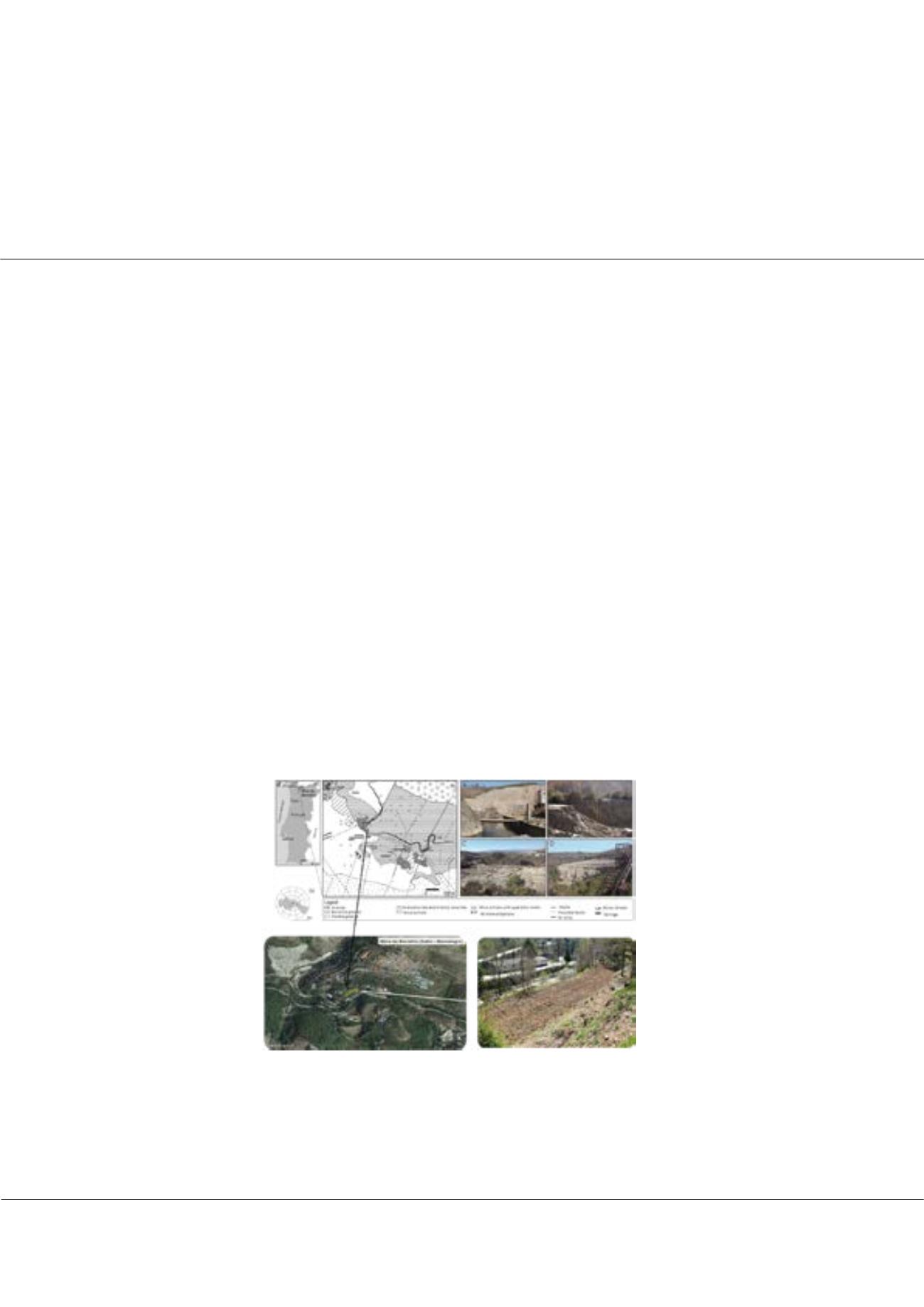
Figure 1:
(a) Location of the study area (b) main geological units and (c) wind rose of the prevailing winds. Main sources of contamination: tailings (A, C, D) with
huge volumes and pond (B) with rejected muds and slush discharged from the ore process. 1) experimental area for phytotechnologies studies and 2) delimited
Sunflower and
Populus
plots where soil was collected.
Paula F Avila et al., J Geol Geophys 2018, Volume 7
DOI: 10.4172/2381-8719-C2-021