


 6 / 13

Page 64
conferenceseries
.com
Volume 7
Journal of Geology & Geophysics
ISSN: 2381-8719
Soil Science 2018
October 22-23, 2018
October 22-23, 2018 | Berlin, Germany
2
nd
Annual Congress on
Soil and Water Sciences
Watershed modeling of sediment and chemical transport in the Malewa river basin, Kenya
Yasser Abbasi
and
Chris M Mannaerts
University of Twente, Netherlands
T
he sediment mobilization and transport behavior and agrochemicals loading of the Malewa river draining into lake
Naivasha, as a major fresh water resource, is a critical issue in relation to water quality and ecosystems in the watershed.
In this study, ArcSWAT v. 2012 was used to estimate discharge, sediment and pesticides (i.e. Lindane, Methoxychlor and
Endosulfan) transport in the Malewa river basin. The model was calibrated and validated in monthly steps using SWAT-CUP
tool in which the sequential uncertainty fitting version 2 (SUFI-2) algorithmwas used to perform the calibration-validation and
sensitivity analysis. SWAT was calibrated using water level gauge data, as well as DTS-12 digital turbidity sensor for suspended
sediment transport. Pesticide residues were sampled at three locations using passive sampling technique and determined using
laboratory gas chromatography. The sensitivity analysis of the discharge-related parameters indicated 15 sensitive parameters
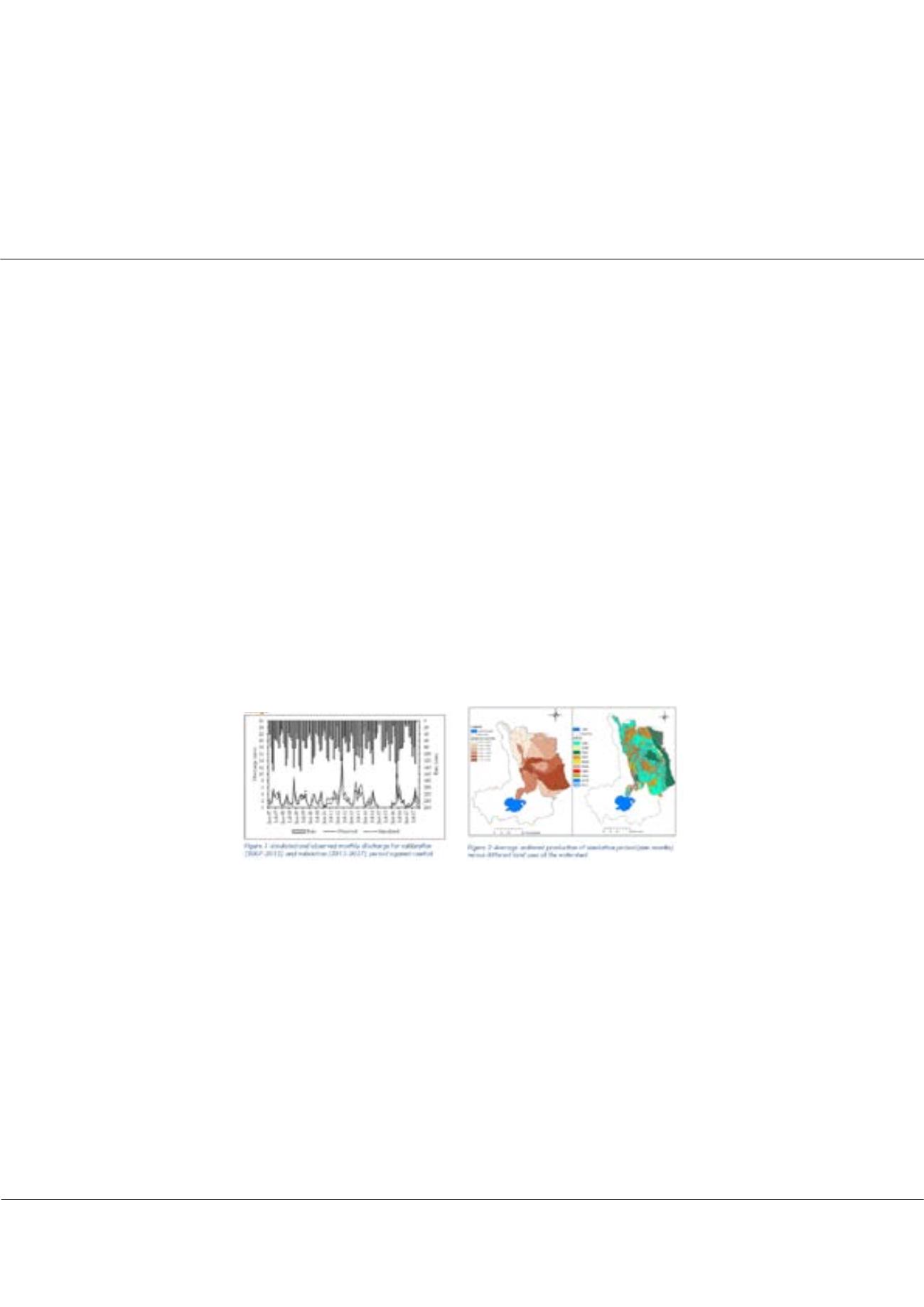
among which curve number (CN2) was the most sensitive one. The results of calibration (2007-2012) showed that the monthly
simulation had satisfactory results with a R2 of 0.74 and NSE of 0.70. The validation (2013-2017) of the discharge simulation
also showed R2=0.69 and NSE=0.59 for monthly simulations. The results of the model calibration for monthly sediments also
showed satisfying results based on R2 and NSE factors as their amounts were both more than 0.90. Among the pesticides-
related parameters, application efficiency (AP_EF) and pesticides half-life in soil (HLIFE-S) were the most sensitive ones in
calibrating the model. Correlation between the simulated and measured pesticides concentrations at upper Malewa and down
Malewa showed that although the model mostly overestimated the pesticides loading, there was a suitable trend between
measured and simulated results. The peak of pesticides concentration happened during May to mid-July. Finally, the results
of this study demonstrated the capability of SWAT model for evaluation of upstream to downstream suspended sediment and
pesticides transport.
Recent Publications
1. Y Liu et al. (2015) Estimating sediment yield from upland and channel erosion at a watershed scale using SWAT. Water
Resour. Manag. 29(5):1399-1412.
2. P Panuwet et al. (2012) Agricultural pesticide management in Thailand : status and population health risk. Environ. Sci.
Policy. 17:72-81.
3. HChen et al. (2017)Modeling pesticide diuron loading from the San Joaquin watershed into the Sacramento-San Joaquin
Delta using SWAT. Water Res. 121:374-385.
4. R W Malone et al. (2015) Parameterization guidelines and considerations for hydrologic models. Transactions of the
ASABE. 58(6):1681-1703.
Biography
Yasser Abbasi is PhD student in department of water resources at the Faculty of Geo-information Sciences & Earth Observation (ITC) of the University of Twente
(NL). His background is soil and water science. Since 2015 he has been focusing on water pollution in the Lake Naivasha, Kenya. This paper presents a part of his
research for modeling agrochemicals transportation in the watershed.
y.abbasi@utwente.nl c.m.m.mannaerts@utwente.nlYasser Abbasi et al., J Geol Geophys 2018, Volume 7
DOI: 10.4172/2381-8719-C2-021