
 Spanish
  Chinese
  Russian
  German
  French
  Japanese
  Portuguese
  Hindi
Hindi Our Group organises 3000+ Global Conferenceseries Events every year across USA, Europe & Asia with support from 1000 more scientific Societies and Publishes 700+ Open Access Journals which contains over 50000 eminent personalities, reputed scientists as editorial board members.
Open Access Journals gaining more Readers and Citations
700 Journals and 15,000,000 Readers Each Journal is getting 25,000+ Readers
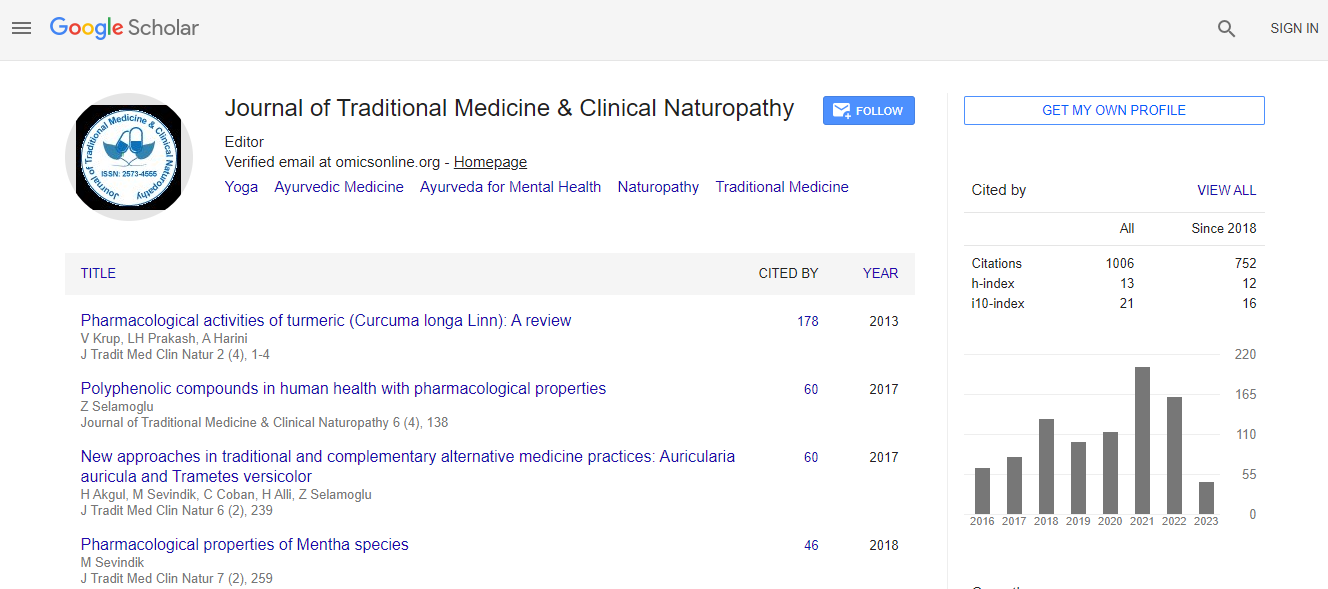
Google Scholar citation report
Citations : 1504
Journal of Traditional Medicine & Clinical Naturopathy peer review process verified at publons

Indexed In
- CAS Source Index (CASSI)
- Google Scholar
- Sherpa Romeo
- Open J Gate
- Genamics JournalSeek
- RefSeek
- Directory of Research Journal Indexing (DRJI)
- Hamdard University
- EBSCO A-Z
- Publons
- Geneva Foundation for Medical Education and Research
- Euro Pub
- ICMJE
Useful Links
Recommended Journals
Related Subjects
Share This Page
GAP-43 protein and its binding lipid phosphatidylinositol-4,5-bisphosphate (PI (4, 5) P2) are required for rapid endocytosis in chromaffin cells
Joint Event on Global Summit on Traditional & Restorative Medicine & 10th World Congress on Neuropharmacology
Fouad Azizi
The Interim Translational Research Institute, Qatar
Posters & Accepted Abstracts: J Tradit Med Clin Natur
Abstract
GAP-43, called neuromodulin, is a major calmodulin (CaM) and PI (4, 5) P2 binding protein that plays a key regulatory role in synaptic plasticity (e.g. learning and memory). CaM is the Ca2+-receptor for rapid endocytosis (RE) established as the clathrin-independent and dynamin-1-dependent mechanism of vesicle retrieval in adrenal chromaffin cells (ACC). Here, we used patch-clamp recording of whole cell membrane capacitance in ACC to monitor exocytosis coupled to RE in response to pharmacological alteration of GAP-43 and PI (4, 5) P2 levels using anti-GAP-43 antibodies and phenylarsine oxide (PAO) respectively. We found that anti-GAP-43 antibodies and PAO completely blocked RE whereas there was no effect on exocytosis or Ca2+ currents. Inclusion of exogenous CaM, dialyzed into the cell via the whole-cell patch pipette, rescued RE in cells treated with anti-GAP-43 antibodies. Similarly, infusion of PI (4, 5) P2 through the patch pipette was able to rescue RE blockade by PAO though with slower kinetics in comparison to control untreated cells. However intracellular delivery of PI (4, 5) P2 precursor, phosphatidylinositol 4-phosphate (PI4P) failed to restore RE in presence of PAO. In absence of PAO, PI (4, 5) P2 and PI4P potentiated and inhibited respectively RE. Application of the bifunctional thiol dithiothreitol to PAO-treated cells completely prevented the inhibitory effect of PAO on RE. Our data indicate show that: GAP-43 is the prime candidate for regulating free CaM levels required for rapid recycling (RE) of vesicles; PI (4, 5) P2 is directly involved in the signaling (mechanistic) process of RE, probably by facilitating CaM sequestration at endocytic sites for vesicle retrieval.Biography
Fouad Azizi has completed his PhD in Biophysical Chemistry at the Center of Molecular Biophysics, National Center for Scientific Research (CNRS), Orleans, France. He has a research track of over 20 years working in US universities on projects related to pulmonary diseases and blood disorders. He has published more than 15 papers in reputed journals and presented more than 15 abstracts at prestigious national and international conferences. Currently, he is a Research Scientist, the Director of Electrophysiology Laboratory and the Manager of Confocal Imaging Core at TRI-HMC. His research interests are related to neurosecretion.
E-mail: fazizi@hamad.qa
