 Spanish
  Chinese
  Russian
  German
  French
  Japanese
  Portuguese
  Hindi
Hindi Our Group organises 3000+ Global Conferenceseries Events every year across USA, Europe & Asia with support from 1000 more scientific Societies and Publishes 700+ Open Access Journals which contains over 50000 eminent personalities, reputed scientists as editorial board members.
Open Access Journals gaining more Readers and Citations
700 Journals and 15,000,000 Readers Each Journal is getting 25,000+ Readers
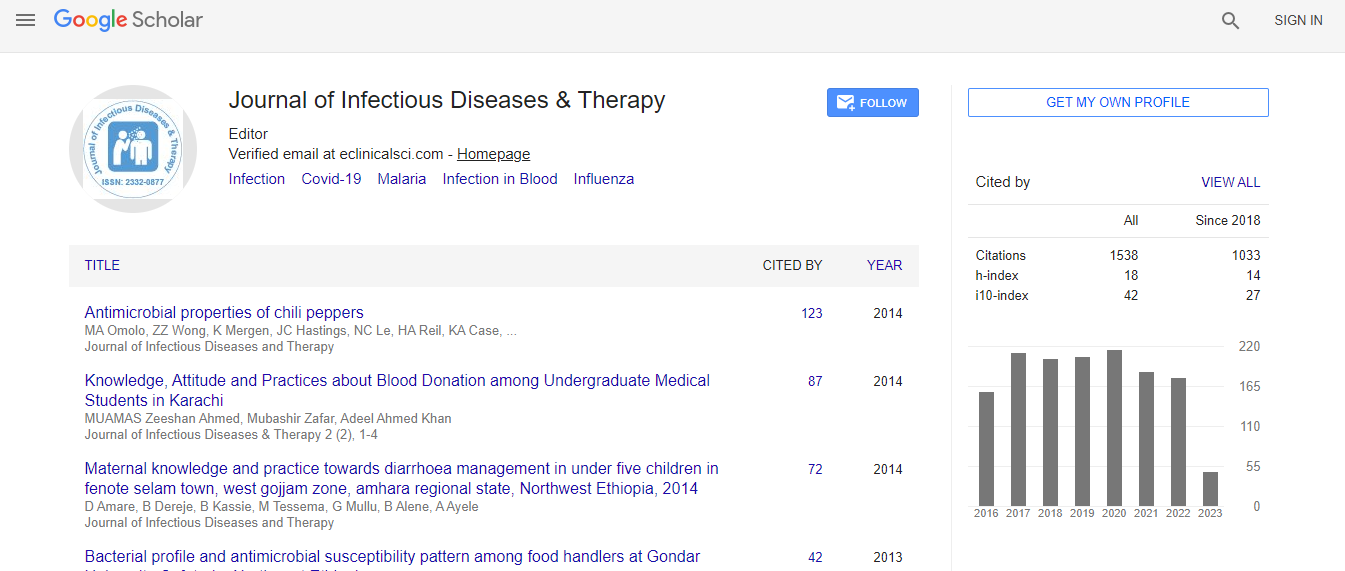
Google Scholar citation report
Citations : 1529
Journal of Infectious Diseases & Therapy received 1529 citations as per Google Scholar report
Indexed In
- Index Copernicus
- Google Scholar
- Open J Gate
- RefSeek
- Hamdard University
- EBSCO A-Z
- OCLC- WorldCat
- Publons
- Euro Pub
- ICMJE
Useful Links
Recommended Journals
Related Subjects
Share This Page
Snakebite envenoming: The most neglected public health crisis
Joint Event on 4th Annual Congress on Infectious Diseases & 5th International Conference on Neglected Tropical & Infectious Diseases
Giulia Ricciardi
Vrije University Brussel, Belgium
Posters & Accepted Abstracts: J Infect Dis Ther
Abstract
Snakebite envenomings are estimated to affect more than 2 million people every year, killing at least 125,000 and leaving about 400,000 with permanent disabilities. People from rural tropical and subtropical regions suffer the highest toll due to the coexistence with venomous snakes and no access to proper treatment. Currently, the only available treatment for snakebite is antivenom, a mixture of antibodies obtained after immunization of a domestic animal with snake venom. Although being effective, antivenoms come with drawbacks such as possible adverse reactions and expensive price. Furthermore, venom is composed of a complex mixture of proteins which can cause a variety of health issues ranging from hemorrhage to paralysis and respiratory failure depending on the snake species, geographical distribution, and ontogeny; hence, the development of a universal antivenom represents a considerable challenge. For all these reasons, in 2017 the World Health Organization included snakebite envenoming in the list of Neglected Tropical Diseases and established a working group of experts to prepare a strategic plan to tackle the global burden of this disease. At the same time, researchers around the world are working intensely on improving the efficacy of antivenoms as well as developing novel therapeutics, while several organizations are operating on a local level spreading awareness about snakebites in rural communities to mitigate the conflicts between humans and snakes. Snakebite envenoming represents a devastating tropical disease that can only be overcome by means of a holistic approach involving the concerted efforts of scientists, policy-makers, pharmaceutical companies, NGOs, and locally-involved organizations.Biography
E-mail: giulia.ricciardi@vub.be
